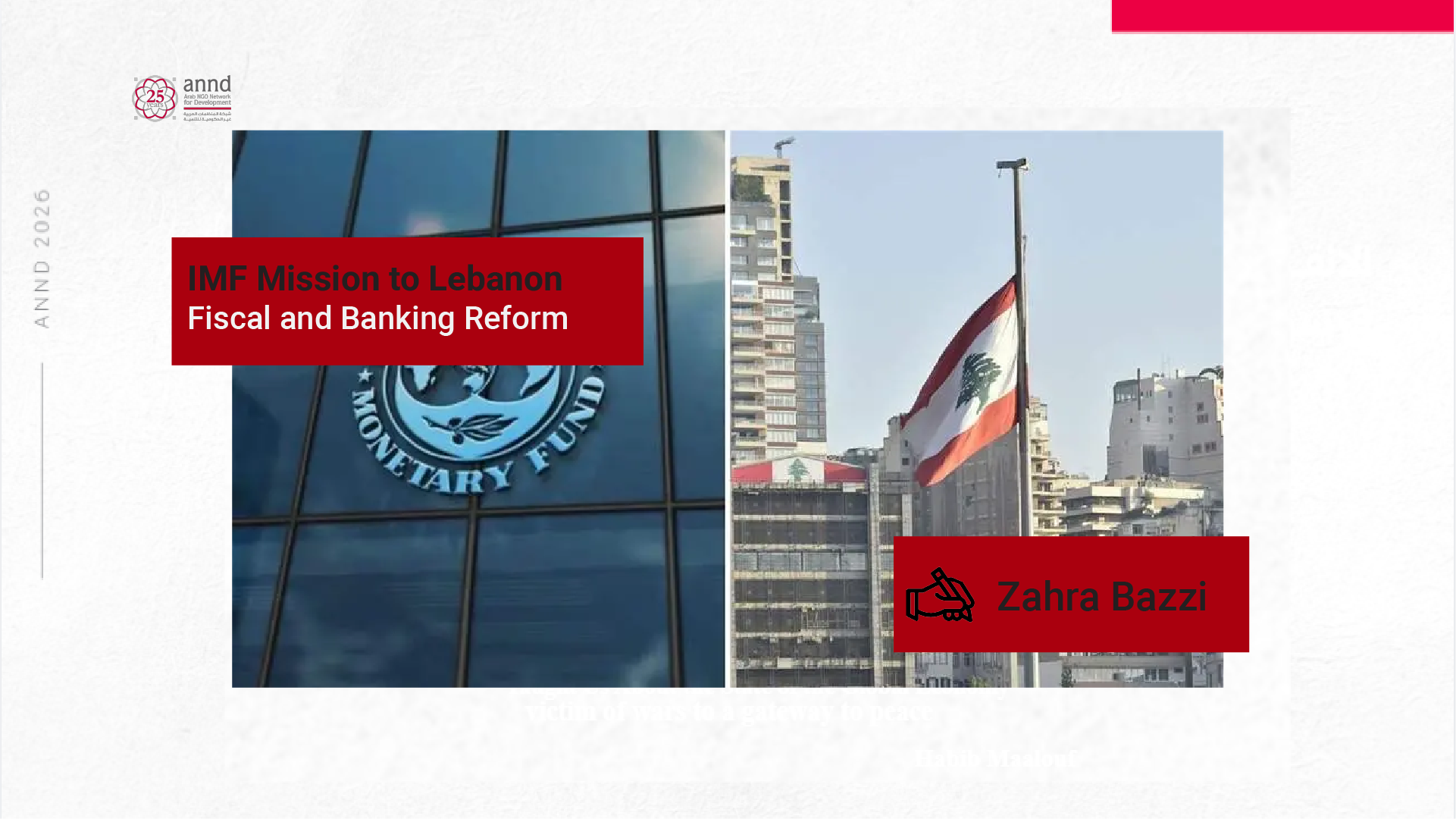
IMF Mission to Lebanon: Fiscal and Banking Reform and the Distribution of Recovery Costs - Zahra Bazzi

IMF Mission to Lebanon: Fiscal and Banking Reform and the Distribution of Recovery Costs
By Zahra Bazzi
The International Monetary Fund mission concluded its visit to Lebanon on 18 September 2026, after four days of discussions with the Lebanese authorities focusing primarily on banking-sector reform, the draft Financial Regularization and Deposit Recovery Law, the draft 2027 budget, and the preparation of a medium-term fiscal framework. The Fund considered the progress achieved—particularly the amendments introduced to the Bank Resolution and Restructuring Law—an important step, while stressing at the same time that a number of essential reforms are still required before moving toward a potential IMF programme.
This comes at a pivotal moment for Lebanon, where three interconnected tracks converge: restructuring the banking sector, restoring fiscal and public-debt sustainability, and financing recovery, reconstruction, and social spending. From the perspective of social and fiscal justice, the central issue lies in the nature of the proposed fiscal reform, how its costs will be distributed, and who will benefit from the recovery process.
This process takes on additional importance in light of World Bank estimates that Lebanon’s economy is expected to contract by 6.4% in 2026, after real growth of around 4.2% in 2025, as a result of renewed conflict and damage to tourism, consumption, investment, and infrastructure. The World Bank also notes that public finances recorded an overall surplus of 3.9% of GDP in 2025, but expects increasing fiscal pressures as a result of humanitarian spending, reconstruction, and pressures on public-sector wages.
From Budget Balance to Fiscal Sustainability
The IMF welcomed the draft 2027 budget, particularly its objective of securing a balanced fiscal position and the measures aimed at improving tax compliance and collection. It also called for adopting an increase in the VAT rate to 12%, fully incorporating externally financed expenditure into the budget, prioritizing support for displaced people, and creating space for investment spending.
At the same time, it warned against further increases in salaries, wages, and pensions without corresponding measures to increase revenues. The Fund also clarified that the increase in VAT to 12% had already been approved by the Council of Ministers but had not yet entered into force, and that it had originally been proposed to finance the salary, wage, and pension increases approved in February 2026.
As the Network noted in its position on the draft 2027 budget, the budget should not be viewed merely as an annual accounting exercise aimed at balancing revenues and expenditures, but as a tool within a medium-term fiscal, economic, and social vision linked to growth, investment, public debt, reconstruction, and social protection.
From this perspective, achieving annual fiscal balance is an important objective, but it is not sufficient in itself to guarantee fiscal sustainability.
From this angle, the IMF’s call to prepare a medium-term fiscal framework represents an important step toward addressing public finances more comprehensively. However, this framework should not be limited to controlling the deficit or balancing revenues and expenditures. It should also determine the level of public spending needed to rebuild the economy and public services, protect incomes, and finance recovery and reconstruction.
Fiscal sustainability does not simply mean reducing spending or increasing revenues. It also means the state’s ability to mobilize sufficient and stable resources to finance its economic, social, and investment functions and preserve its ability to respond to crises over the medium and long term.
It is important here to distinguish between annual fiscal balance and fiscal sustainability. The World Bank noted that Lebanon achieved an overall fiscal surplus of 3.9% of GDP in 2025, yet this was not sufficient to address the public-debt problem or the need for investment and social spending, while public debt remained unsustainable. This shows that achieving a surplus or balance in a given year does not necessarily mean that public finances have become sustainable.
As for salaries and wages, continuing to rely on an ad hoc approach based on temporary increases is not commensurate with the scale of the deterioration in the incomes of workers and retirees during the crisis years, nor does it provide a stable and sustainable foundation for public finances.
There is therefore a need to reform the salary and wage structure within a medium-term fiscal framework that ensures the sustainability of its cost. Wage reform should be accompanied by public-administration reform and improved spending efficiency.
Accordingly, warnings against further salary and wage increases should not become a freeze on addressing the wage crisis. Rather, they should serve as an entry point for moving from exceptional measures toward structural wage reform financed within a medium-term fiscal vision that distributes public resources more fairly.
Increasing Revenues and Tax Justice
The IMF emphasizes the importance of strengthening domestic revenues and improving tax compliance, and calls for moving forward with raising VAT to 12%.
There is no doubt that Lebanon needs to strengthen its revenue-collection capacity and combat tax evasion. But how revenues are increased is no less important than the amount raised.
At a time when household purchasing power has declined, poverty levels have risen, and public services have deteriorated, increasing reliance on indirect taxes—particularly VAT—raises serious questions about the distribution of the tax burden.
Greater reliance on consumption taxes does not necessarily constitute a sustainable revenue path either, particularly in an economy suffering from weak growth and declining real incomes, and in a region marked by recurring economic, political, and security crises and conflicts.
When consumption declines because of falling purchasing power or economic shocks, revenues that depend on consumption are affected precisely when the need for spending on social protection, public services, recovery, and reconstruction increases.
Building public finances around higher consumption taxes may therefore create a paradox: increasing the burden on households in the short term without necessarily providing a more stable and crisis-resilient revenue base.
The importance of the current economic situation is evident here. The World Bank expects inflation in Lebanon to rise to 17.5% in 2026, driven by supply disruptions and higher shipping costs and oil prices, adding further pressure on household purchasing power. It has also noted that higher oil prices have a direct impact on Lebanon because of its heavy dependence on oil for electricity and transport.
From the perspective of tax justice and fiscal sustainability, revenue increases should not be built around expanding reliance on indirect taxes, particularly consumption taxes, merely because they are a quick and easy source of collection.
These taxes shift a greater share of the burden onto households and become a more fragile source of revenue in economies suffering from declining purchasing power and recurring shocks.
Strengthening public finances therefore requires rebalancing the revenue structure toward direct and progressive taxation, combating tax evasion, reviewing exemptions, incentives, and tax expenditures, and increasing the contribution of those with higher incomes, wealth, and property who have a greater ability to pay.
This direction does not necessarily contradict positions previously advanced by the IMF itself. In 2023, the Fund called for broadening the tax base, closing loopholes, improving compliance, and strengthening tax administration in order to increase revenues and create space for social and development spending. It also called for adopting a more modern and effective income-tax law.
Banking-Sector Reform and the Distribution of Losses
The IMF welcomed the amendments introduced to the Bank Resolution and Restructuring Law, considering them to provide a more orderly framework for addressing and liquidating distressed banks.
At the same time, however, it stressed the need to amend the draft Financial Regularization and Deposit Recovery Law in line with international standards regarding the hierarchy for bearing losses.
This is an important step, but it does not exhaust the core of the problem.
Lebanon’s banking crisis is not merely a technical issue concerning how to deal with or liquidate a distressed bank. It is part of a broader financial crisis linked to massive losses accumulated since the collapse, the liabilities of Banque du Liban, public debt, and the fate of deposits.
World Bank estimates indicate that financial losses exceeded USD 72 billion in its initial assessment, and later exceeded USD 75 billion in a more recent 2024 estimate—an amount several times the size of GDP.
The World Bank’s analysis also showed that around 73% of banking-sector assets at the end of 2023 were linked to the public sector and Banque du Liban, and that around 88% of this share took the form of deposits at Banque du Liban.
This illustrates the scale of the interconnection among the state, Banque du Liban, and commercial banks that lay at the heart of the crisis.
Banking-sector restructuring should therefore be based on full and transparent recognition of the scale of the losses and the identification of their sources and the responsibilities of the different parties before determining how those losses should be distributed.
That distribution should also respect the legal hierarchy of loss-bearing, so that depositors do not become the easiest party on whom to impose the cost of the crisis and public finances do not automatically become a mechanism for compensating private-sector losses.
This point clearly aligns with the IMF’s current position. In its September 2026 statement, the Fund stressed the need to respect the hierarchy of claims, so that depositors do not bear losses before shareholders and lower-ranking creditors.
It also emphasized that any deposit-repayment plan must be consistent with banking-sector viability and public-debt sustainability.
This issue is particularly important given the state’s limited financial resources and its substantial needs in social protection, reconstruction, services, and investment.
Any public contribution to addressing banking-sector losses must therefore be clear, defined, and sustainable, and must be assessed within the framework of public finances and public debt rather than treated as an obligation separate from other social and economic priorities.
The connection between the Bank Resolution and Restructuring Law and the Financial Regularization and Deposit Recovery Law is especially important in this context.
The first law essentially determines how distressed banks should be handled, restructured, or liquidated, while the second addresses the broader framework for dealing with financial imbalances, recovering deposits, and distributing losses.
It is worth recalling that the World Bank previously warned that fully financing banking-sector losses from public funds would be unsustainable because the scale of the losses far exceeds the state’s capacity to mobilize the necessary assets and revenues.
In 2022, the Bank described the financial sector as “too big to bail” through available public resources, in light of losses exceeding USD 72 billion at the time.
Social Protection as Part of Fiscal Sustainability
In its statement, the IMF points to the need to create fiscal space for reconstruction and social protection and also calls for prioritizing support for displaced people.
This is important, but social protection should not be treated as residual spending left over after restructuring the financial sector and controlling expenditure.
Years of crisis have severely eroded household incomes and people’s access to essential services, while infrastructure and public services have suffered additional damage as a result of conflict and displacement.
Building a sustainable and adequately financed social-protection system must therefore form part of the medium-term fiscal and economic framework rather than serve merely as a temporary mechanism for compensating the poorest groups for the effects of reform.
Financing social protection also requires sustainable domestic resources rather than continuous dependence on external financing or emergency programmes.
This issue takes on even greater importance in light of current needs.
In January 2026, the World Bank approved a USD 350 million financing package to support social protection, economic empowerment, and digital transformation in Lebanon, focusing on poor and vulnerable groups and improving systems for delivering social protection and public services.
This figure alone does not represent the full scale of need, but it does indicate that social protection has become part of the economic-recovery agenda rather than merely a temporary humanitarian response.
The World Bank also noted that food insecurity declined from a peak of 24% in late 2024 to around 13% in early 2026, before the renewed conflict, although it remained high by historical standards.
With displacement and destruction expanding in 2026, the need for social protection and spending on essential services is likely to increase further.
Fiscal and Banking Reform and Rebuilding the Economy and the State
The IMF mission’s September statement represents an important milestone in Lebanon’s economic and fiscal reform process and clearly identifies the Fund’s priorities, foremost among them fiscal sustainability, banking-sector restructuring, reform of the deposit-recovery framework, revenue enhancement, and the establishment of a medium-term fiscal framework.
But the success of reform is not measured only by controlling the deficit or achieving budget balance.
It is also measured by its ability to rebuild an economy capable of creating jobs, a state capable of providing public services, a fairer tax system, sustainable social protection, and a banking sector that protects depositors’ rights, while ensuring a fair and transparent distribution of the crisis losses.
The past years have shown that delaying recognition of losses does not eliminate them. Rather, it gradually transfers their cost to households and society through inflation, the erosion of wages and incomes, restrictions on deposits, and declining public services.
Likewise, increasing indirect taxes or cutting spending without more deeply addressing the sources of dysfunction may limit the economy’s capacity to recover.
Fiscal and banking reform should therefore form part of a broader process of rebuilding the economy and the state, based on fairness in distributing the cost of the crisis, transparency and accountability, tax justice, protection of depositors, provision of social protection, and preservation of the state’s capacity to invest in recovery and reconstruction.
Recent developments underscore the scale of the challenge.
The World Bank expects the economy to contract by 6.4% in 2026 after having estimated real growth of around 4.2% in 2025, while the IMF confirms that the conflict and regional developments have caused widespread damage to infrastructure and housing, large-scale displacement, and deterioration in living standards.
Rebuilding public finances and the banking sector therefore cannot be separated from the question of financing recovery itself.
From this perspective, the central issue is not simply: how much will reform cost?
It is also: who will bear this cost, when, through what instruments, and who will benefit from the resources that become available after reform?
Lebanon’s experience has shown that the absence of a decision on how losses should be distributed does not mean that those losses disappear. Rather, it results in their hidden distribution through inflation, the erosion of savings, declining real wages, restrictions on deposits, and deteriorating public services.
Clear rules for distributing losses, alongside clear rules for revenue mobilization and expenditure, should therefore form an essential part of any medium-term fiscal framework.
Recent publications
Lebanon’s Reform Moment: From Fiscal Repair to Rebuilding the State - Lamia Moubayyed