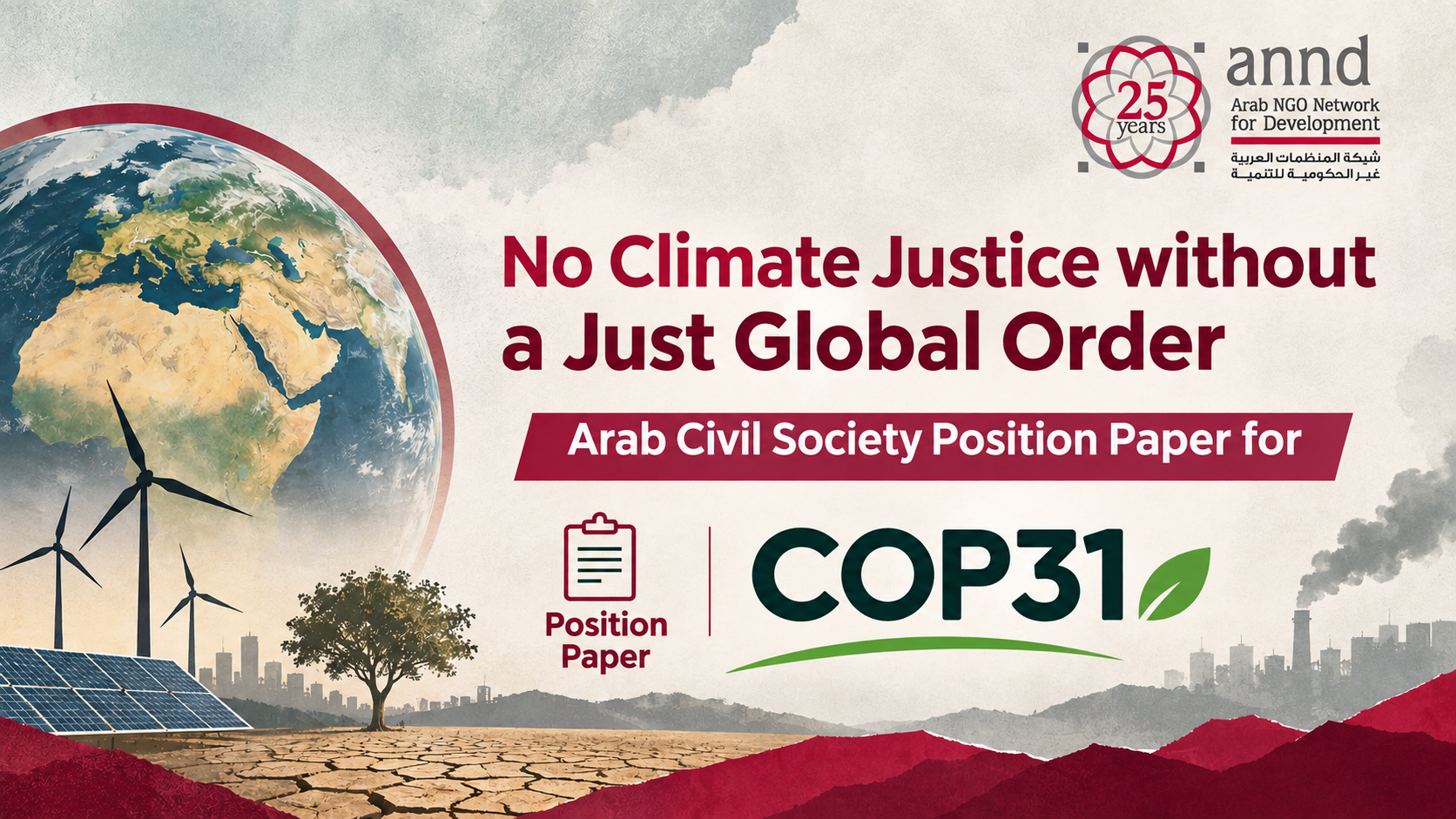

Arab Civil Society Position Paper for COP31
No Climate Justice without a Just Global Order
We enter the Conference of the Parties (COP) process on the premise that the climate crisis reflects deep imbalances in the global economic and political order: in patterns of production, consumption and resource extraction, wealth and technology distribution, and decision-making power. Arab societies face compounding impacts of climate change, wars, occupation and debt, which undermine their rights to water, food, energy and livelihoods, as well as their capacity to adapt.
We demand that the transition from pledges to implementation be grounded in historical responsibility, social justice and human rights. Developing countries must not be made to bear the cost of the transition while finance and technology gaps persist, nor may the prospect of exceeding the 1.5°C goal be used as a pretext for abandoning it. We uphold the independence of civil society from government positions, and its right to hold states and corporations accountable and to build alliances around the demands of communities.
1. Ensuring Accountable Implementation and Meaningful Community Participation
The credibility of climate action requires linking ambition to the means of implementation, measurement and accountability. Communities must take part in shaping and monitoring policies, and national circumstances must not become a cover for shortcomings, corruption or the exclusion of civil society.
Our demands
• Raise the ambition of Nationally Determined Contributions (NDCs) in line with science, equity and historical responsibilities, while providing the finance, technology and capacity-building needed to implement them.
• Assess national plans against their emission reduction targets, sources of finance, technology needs, legislative and policy changes, and community participation; and link them to clear indicators, timelines and responsibilities.
• Protect civic space and guarantee the participation of local communities, workers and small-scale farmers in the formulation, implementation and accountability of climate policies.
2. Reclaiming Climate Finance as a Commitment to Justice and Reparation
Climate finance is a responsibility owed to countries and communities that bear harms they did not cause to the same degree. It must expand their capacity to protect rights, and must not reproduce dependency or deepen debt servicing burdens.
Our demands
• Establish a clear and measurable pathway for delivering the finance goal and the Baku to Belém Roadmap, scaling up international public finance and prioritizing grants and concessional finance that do not exacerbate indebtedness.
• Ensure transparent differentiation between grants, loans, private investment, and domestic and international public finance; commercial loans and private investments must not be counted as substitutes for the obligations of developed countries.
• Increase finance for adaptation and for loss and damage, simplify fund access requirements, and ensure that resources reach local communities and conflict-affected countries.
• Cancel or restructure the unsustainable debt of the most vulnerable countries, reform the international financial system, and recognize the historical climate and ecological debt.
• Mobilize new resources based on the polluter-pays principle, including levies on fossil fuel extraction and windfall profits, aviation, shipping, extreme wealth and speculative financial activities, provided these are additional to the obligations of developed countries.
3. Operationalizing a Just Transition That Transforms Patterns of Production and Consumption
We support a gradual and just global transition away from fossil fuel dependence, while ensuring energy security and affordability, the rights of workers and communities, and sovereignty over natural resources. We reject replacing oil extractivism with mineral extractivism that reproduces inequality and dependency.
Our demands
• Support equitable national transition pathways that take into account historical responsibilities and national circumstances, while ensuring finance, technology transfer, economic diversification, and the protection of jobs and livelihoods.
• Implement the Belém Technology Implementation Programme, and link technology transfer and localization to compensation for climate harm; remove intellectual property barriers to clean technologies, and facilitate licensing, open data, research and local manufacturing.
• Promote maintenance, reuse, recycling, recovery and extended producer responsibility, while reducing unnecessary consumption and demand for raw materials.
• Prevent destructive mining, protect the rights of workers and local populations, and transfer processing and refining technologies to increase value added in producing countries.
• Advocate for treating critical minerals as a public resource, shielding them from conflict, monopoly and trade rules that entrench control over them, and developing international governance frameworks for their management under UN auspices.
4. Addressing War, Militarization and Occupation, and Incorporating Their Climate Impacts
Wars increase emissions; destroy water, land, ecosystems and infrastructure; and divert resources from development and adaptation toward armament. The military sector and the impacts of conflict must not be excluded from climate accounting, nor should climate security be used to justify further militarization.
Our demands
• Integrate the nexus between war, climate and peace into negotiations and into reporting and transparency mechanisms, and ensure that the military sector is not exempted from climate responsibility.
• Improve reporting on direct and indirect military emissions, including those resulting from international operations, and develop methodologies to assess the environmental and climate damage caused by war and occupation.
• Establish mechanisms to compensate those affected and hold those responsible for wars accountable for the resulting damage, and impose a climate levy on global arms companies.
• Strengthen the climate, peace, relief and recovery track in line with the needs of conflict-affected communities and countries, and address the drain of public resources into armament.
5. Operationalizing the Loss and Damage Fund and Strengthening Legal Accountability
Loss and damage is an entitlement of justice, not charity. The response must be commensurate with the scale of the harm and accompanied by means to hold states and corporations accountable for their obligations and responsibilities.
Our demands
• Provide new, additional and adequate funding to the Fund for Responding to Loss and Damage, simplify access to it, and ensure that funding reaches affected countries and communities.
• Leverage the International Court of Justice’s advisory opinion on state climate obligations to strengthen accountability, protect human rights and the rights of future generations, and clarify the duty of due diligence.
• Support climate litigation and claims for compensation for transboundary harm, and develop legal claims against states and corporations that cause harm or fail to meet their obligations.
• Use legal frameworks as a lever for political and public pressure, and link finance and compensation to historical responsibility and the ability of affected people to reclaim their rights.
6. Placing Water and Food Sovereignty at the Heart of Adaptation
Adaptation is a priority equal to mitigation and a matter of survival for arid and semi-arid countries. Water is the link between climate, food, health, energy and displacement, and the rights of communities must govern investment decisions in this sector.
Our demands
• Integrate the right to water and the protection of river basins, groundwater, ecosystems and transboundary waters into national plans and adaptation finance.
• Support demand management, reduce network losses, safe water reuse, drought and flood preparedness, and early warning systems; and assess environmental and social impacts before expanding major infrastructure projects.
• Protect small-scale farmers, local seeds, soils and agricultural biodiversity; support agroecology and locally adapted varieties; and reduce dependence on imported inputs.
• Challenge the monopolization of seeds and agricultural technology, reject the reduction of agriculture to carbon sequestration and carbon markets, and strengthen food sovereignty.
• Finance locally led adaptation that covers health, cities, extreme heat, desertification, coastal zones, migration and displacement, alongside water and agriculture.
7. Addressing Monopoly and Green Protectionism, and Ensuring Environmental Integrity
Climate policies must not become tools for transferring wealth from the South to the North, or markets that allow pollution and monopoly to persist. Accountability must extend to trade, carbon, technology and resource supply chains.
Our demands
• Safeguard the environmental integrity of Article 6 of the Paris Agreement, and ensure that carbon credits are not used as a substitute for direct emission reductions or as a way to evade historical responsibility; prevent double counting, and guarantee transparency and the rights of communities and Indigenous Peoples.
• Address the inequitable impacts of the Carbon Border Adjustment Mechanism (CBAM) and other unilateral trade measures; provide finance and technology to developing countries, and channel revenues generated by carbon mechanisms toward supporting their transition.
• Open a dialogue between the United Nations Framework Convention on Climate Change (UNFCCC) and the World Trade Organization (WTO), put an end to tariff wars that hinder renewable energy and technology transfer, and safeguard the right of developing countries to development.
• Ensure that any carbon pricing for maritime shipping is fair, transparent and non-discriminatory, and allocate part of its revenues to supporting the maritime transition in developing countries.
• Require artificial intelligence companies and data centers to disclose their carbon and water footprints and resource consumption; establish environmental, social and ethical safeguards, and involve communities in decisions on their expansion.
• Make digital technologies accessible to developing countries for early warning systems, water management, agriculture and disaster management, while protecting data and public knowledge and preventing their use to expand unregulated resource extraction.
Our Approach to COP31
We bring to the conference an agenda that links emission reductions to finance, compensation, and technology transfer, the protection of water and food, and efforts to address militarization. We work to turn these demands into measurable and monitored commitments, and to link international engagement with accountability for national policies and plans.
We converge with the Arab Group and developing-country blocs on historical justice, finance, technology and the rejection of unilateral measures, while maintaining an independent position on a just transition away from fossil fuels, human rights, governance and corporate accountability. We build issue-based alliances, without reducing community interests to fixed governments alignments.
Climate justice cannot be achieved without re-examining the relationships that generate the crisis and distribute its burdens unequally, and without redirecting resources and decision-making power toward people’s rights and their ability to protect their future.
Recent publications