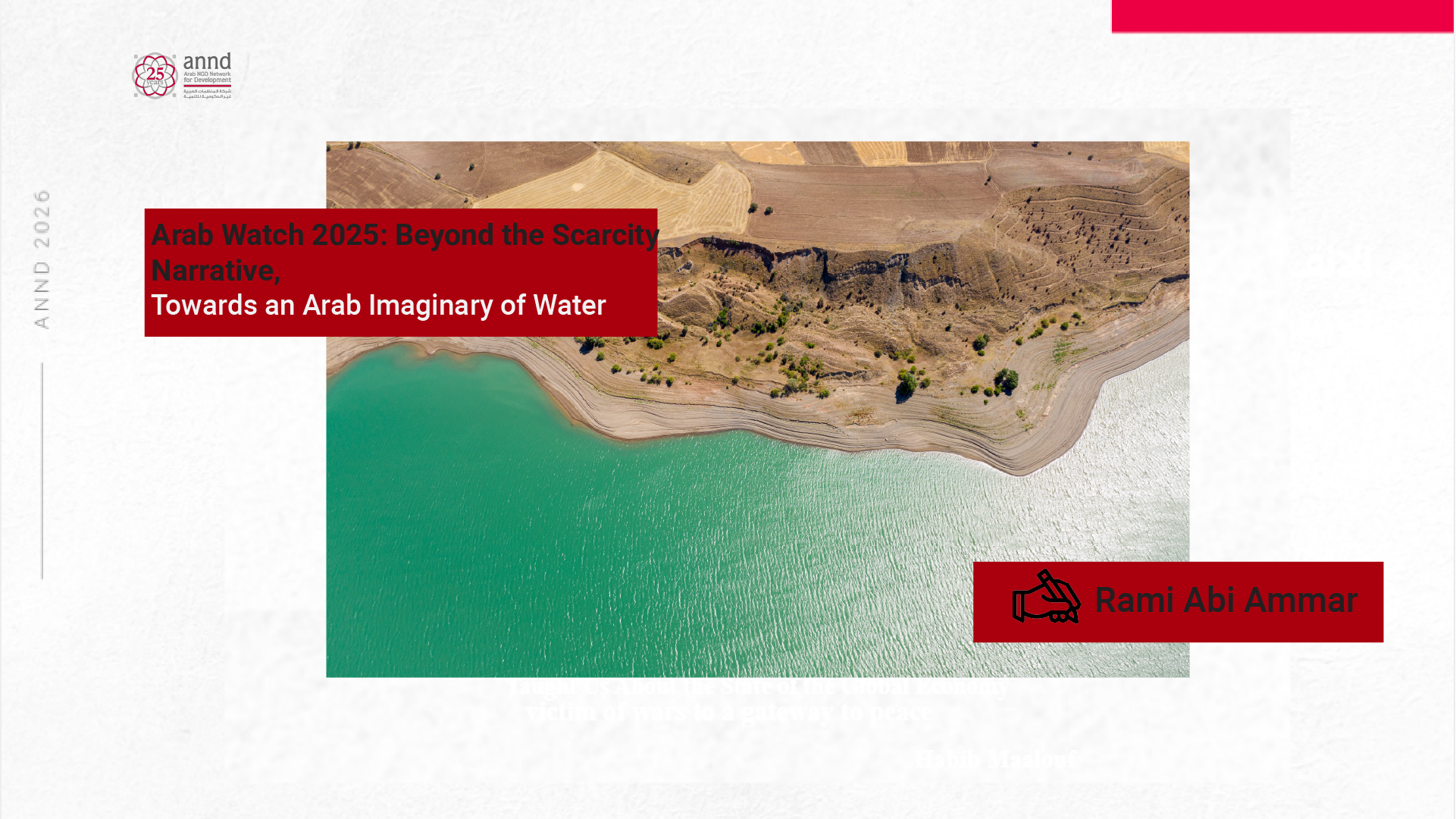
Arab Watch 2025: Beyond the Scarcity Narrative, Towards an Arab Imaginary of Water Justice - Rami Abi Ammar

Arab Watch 2025: Beyond the Scarcity Narrative, Towards an Arab Imaginary of Water Justice
Placing Water at the Heart of the Political and Development Question
With the launch of the 2025 Arab Watch for Economic and Social Rights on the right to water and climate change, we were not so much announcing the completion of a report as opening a confrontation with the narratives that interpreted the water crisis through the dryness of the land while concealing, behind the language of scarcity, relations of control, occupation, and commodification. Arab Watch sought to place water at the heart of the political and development question in the Arab region. The water traced by the reports is not a silent resource, but a record of the transformations that have affected the state, society, and development models across the region. After a process of research and dialogue extending over three years, this issue concludes a phase of Arab Watch’s work, but it does not close the issue it addresses.
Water as a Hydro-Social Relationship
Water is not a natural resource existing outside society, with policies intervening only later to manage it. Rather, it is a hydro-social relationship produced at the intersection of nature with power, law, ownership, labour, technology, and capital. Water shapes societies just as societies shape its pathways and meanings: dams, networks, and wells determine patterns of settlement and production, while institutions and power balances determine where water flows, to whom, and at what quality and cost. From this perspective, scarcity is not a purely natural fact, but the outcome of the interaction of climate and geography with political and economic choices that prioritize certain uses and groups over others. Water may be available for real estate projects, export-oriented agriculture, and extractive industries, while entire villages and neighbourhoods remain at the margins of supply networks. It is therefore not enough to ask how much water is available. More important is to question who defines scarcity, who controls the resource, which interests are supplied, and who pays the price of pollution, interruptions, and depletion.
Colonial Imaginaries and the Commodification of Water
These relationships were not formed in isolation from history. Colonial imaginaries portrayed the environments of the Middle East and North Africa as dry and degraded because of the mismanagement of their inhabitants, and presented surveying, codification, and centralized engineering as tools for “saving” nature, while using them to reorganize ownership, dispossess land, and marginalize local and collective systems of management. In Palestine, the imaginary of “making the desert bloom” was linked to a settler-colonial project that transformed the discourse of scarcity into a basis for seizing water rights and controlling land and people. Even after independence in some countries of the region, some of these structures continued within major water modernization projects, before neoliberalism reformulated them through the language of efficiency, cost recovery, and attracting private investment. Water thus shifted in policy from a right and public service to an economic resource, while the citizen shifted from a rights-holder to a customer whose entitlement is measured by the ability to pay.
The Intervention of Arab Watch 2025
This colonial, developmental, and neoliberal legacy is the field in which Arab Watch 2025 intervenes. Through eight national reports, five case studies, five thematic papers, and a regional report covering thirteen Arab countries, Arab Watch shifted the discussion from the technical management of scarcity to the political economy of the right to water. It did not treat water crises as isolated events, but linked them to development patterns, weak public institutions, social, spatial, and gender inequalities, occupation and conflict, urban expansion, intensive agriculture, extractive activities, pollution, and climate change.
Commodification Through the Decline of Public Services
The Arab Watch reports reveal that the commodification of water does not necessarily begin with an officially announced privatization decision. The private market may grow from within the decline of the public service itself. When networks become intermittent or unsafe, households are forced to purchase water from tankers, rely on bottled water and private wells, and pay the costs of pumping, storage, and purification. An unequal water system thus emerges: a deteriorating public service for those unable to purchase alternatives, and multiple markets for those with financial means. Households bear the cost twice, through public fees and the purchase of alternative water, while women bear an invisible share of the labour required to secure and manage water within the home.
Different Forms of Water Domination
This process intersects with different forms of water domination. In Palestine, domination is based on settler-colonial control over land, aquifers, infrastructure, permits, and freedom of movement. In Syria, Yemen, Sudan, Libya, and Lebanon, water appears as both a victim of war and a potential instrument of siege, subjugation, and displacement. In other contexts, domination operates through the conditions attached to loans and aid, monopolies over data and expertise, the prioritization of large-scale projects, and the diversion of water towards influential agricultural, real estate, or industrial sectors. Domination therefore does not mean only one state’s control over a shared river, but also the ability to determine which use of water is considered productive, which group deserves it, and which loss can be treated as an acceptable side effect.
From Diagnosis to a Reform Programme
Arab Watch challenges this structure by combining a human rights approach with political ecology and by transforming diagnosis into a reform programme. Its reports’ recommendations converge around the need for explicit legal recognition of water as a human right and a common good, and for translating this recognition into enforceable obligations. This includes guaranteeing a sufficient, safe, and affordable minimum for everyone, adopting social and progressive tariffs that take income and household size into account, and preventing water disconnections for those unable to pay. The reports also call for prioritizing domestic uses, ecosystems, and local livelihoods over water-intensive commercial and extractive activities, and for subjecting major users, private wells, tanker markets, and bottled water to effective regulation and oversight.
Rebuilding and Fairly Financing Public Institutions
The reports do not consider that the solution to declining public services lies in further privatization or recovering costs from households, but rather in rebuilding public institutions and financing them fairly and sustainably, investing in network maintenance, reducing pollution and leakage, and expanding sanitation and treatment services. They recommend subjecting loans, public-private partnerships, and donor conditions to transparent human rights and environmental assessments, and publishing contracts, data, budgets, and the results of water quality testing, while establishing independent mechanisms for complaints and accountability. Financial sustainability cannot be separated from social justice, and efficiency is not measured solely by fee collection, but by the system’s ability to guarantee a safe, regular, and equitable public service.
Communities as Rights-Holders and Partners
Arab Watch’s recommendations affirm that communities are not merely “beneficiaries” of policies formulated far from them, but rights-holders with knowledge and an inherent role in determining the future of their resources. They therefore call for their effective participation, particularly that of women, farmers, workers, refugees, persons with disabilities, and marginalized groups, in water planning, management, and monitoring. They also call for the protection of collective management systems and traditional knowledge as part of a living water heritage.
Towards a More Deeply Rooted Arab Water Imaginary
From this perspective, Arab Watch contributes to building a more deeply rooted Arab water imaginary that sees water not as a figure in a water balance or a replaceable economic asset, but as a right, a common good, and a cultural and social relationship with the land. Springs, wells, aflaj, irrigation channels, and collective irrigation systems contain knowledge of seasons and the environment, as well as memories of labour, solidarity, and belonging. Recognizing them does not mean romanticizing practices that may themselves reflect class and gender inequalities, but rather preserving the knowledge they carry and rebuilding them on the foundations of equality, participation, and justice. This imaginary also extends to confronting the transformation of water into an instrument of domination and violence by protecting infrastructure during conflicts, holding accountable those responsible for targeting it or using it for siege and displacement, and managing shared resources according to the principles of equity, cooperation, and popular sovereignty.
“What it has presented is not an additional description of the water crisis, but a framework for understanding and confronting it.”
From Managing Shortage to Questioning Power
In this concluding issue, Arab Watch 2025 brings a phase of research and dialogue to a close, but does not place a final full stop in the discussion it has opened. What it has presented is not an additional description of the water crisis, but a framework for understanding and confronting it: a framework that moves us from managing shortage to questioning power, from treating people as consumers to recognizing them as rights-holders and partners in decision-making, and from reducing water to its economic value to reclaiming it as a foundation of life and of the relationship with place.
The Future of Water and the Future of Justice
This is the message left by Arab Watch. The future of water cannot be separated from the future of justice in the Arab region. Water carries the history of the land and the memory of communities, just as it carries the effects of occupation, war, inequality, and the decisions that have made thirst a fate for some and a purchasable privilege for others. Reclaiming it from the logic of control and profit is not a return to the past, but a step towards a future in which development is measured by its ability to protect life and dignity, rather than by how much it extracts from the earth or turns into profit.
Recent publications
From the Devastation of War to the Breakdown of Public Administration: How Were Lebanon’s State Institutions Depleted?