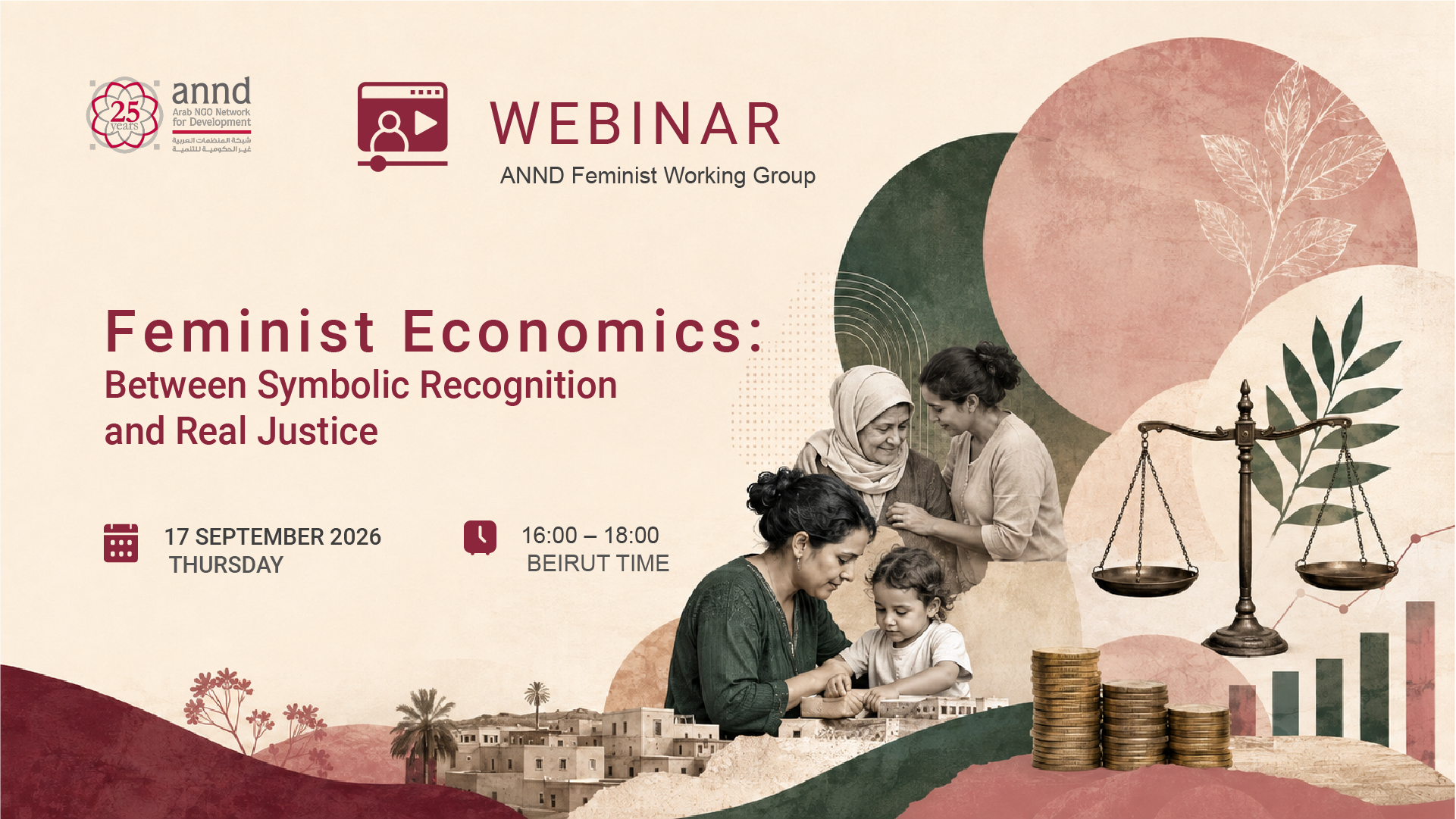
Webinar: Feminist Economics: Between Symbolic Recognition and Real Justice
Feminist Economics: Between Symbolic Recognition and Real Justice
Date: 17 September 2026
Time: 4:00 PM Beirut Time
Moderator: Hadeel Qazaz (Gender Justice Coordinator for South West Asia and North Africa (SWANA) at Oxfam)
Featured Speakers: Lina Abou Habib (Director, Asfari Institute for Civil Society and Citizenship, AUB) and Shereen Talaat (Director and co-founder of the MENA Fem Movement).
Feminist economics did not begin as a slogan, but with a question raised by economist Marilyn Waring in 1988: Why is a woman’s work in a factory or office counted as part of a country’s economic output, while her work raising children or caring for elderly parents at home is not?
This question helped shape what is now known as the care economy, a field that challenges conventional assumptions about whose work is counted, how it is valued, and who bears its costs. These ideas have increasingly influenced public policy. The United Nations has introduced approaches to measuring unpaid domestic work, more than one hundred countries have taken steps toward gender-responsive budgeting, and countries across the Arab region, including Jordan, the United Arab Emirates, Egypt, and Morocco, have introduced legislative and institutional measures reflecting similar concerns.
The webinar organized by ANND's Feminist Working Group takes this question as a starting point to examine the gap between the growing recognition of care work and the achievement of substantive economic justice. The discussion will explore whether legal and economic reforms are reaching women beyond formal urban centres, whether different approaches to valuing unpaid care work actually lead to a fairer distribution of resources, and how civil society can advance a feminist economic approach that connects gender justice with broader questions of social, environmental, tax, and fiscal justice.
Key Areas of Discussion
To what extent have legal and economic reforms actually reached women outside formal urban centres, including women farmers, workers in the informal economy, and women living farther from centres of decision-making? To what extent do cultural norms around who provides care and who participates in paid work remain an independent barrier that legal reform alone cannot overcome?
Do approaches to valuing domestic and care work—from marital wealth-sharing models in Europe to the concept of “kadd wa si'aya” in Morocco and the inclusion of unpaid work in official statistics—lead to a meaningful redistribution of resources? Or does financial or symbolic recognition risk becoming a politically easier substitute for deeper reforms that challenge existing centres of power?
Do civil society organizations in the Arab region have the capacity and independence to play a stronger role in tracking public budgets, monitoring policies, and holding governments accountable? Can civil society actors advance a feminist economic approach that connects gender justice with environmental justice, tax justice, and fiscal policy rather than addressing each issue in isolation?
The session will be moderated by Hadeel Qazaz, with Lina Abou Habibi and Shereen Talaat joining as featured speakers. The webinar seeks to open a broader discussion on how to move from symbolic recognition of care work and women’s economic contributions toward policies that more fairly redistribute resources, responsibilities, and decision-making power, while positioning feminist economics within the wider struggle for social and economic justice in the Arab region.
Recent publications
Who Enters the Age of Electricity? And Who Pays the Price? - Habib Maalouf