
Women Guardians of Water: On Power, War, and Survival
Gihan Abou Zeid
When Water Is Taken Away, an Entire Way of Life Disappears
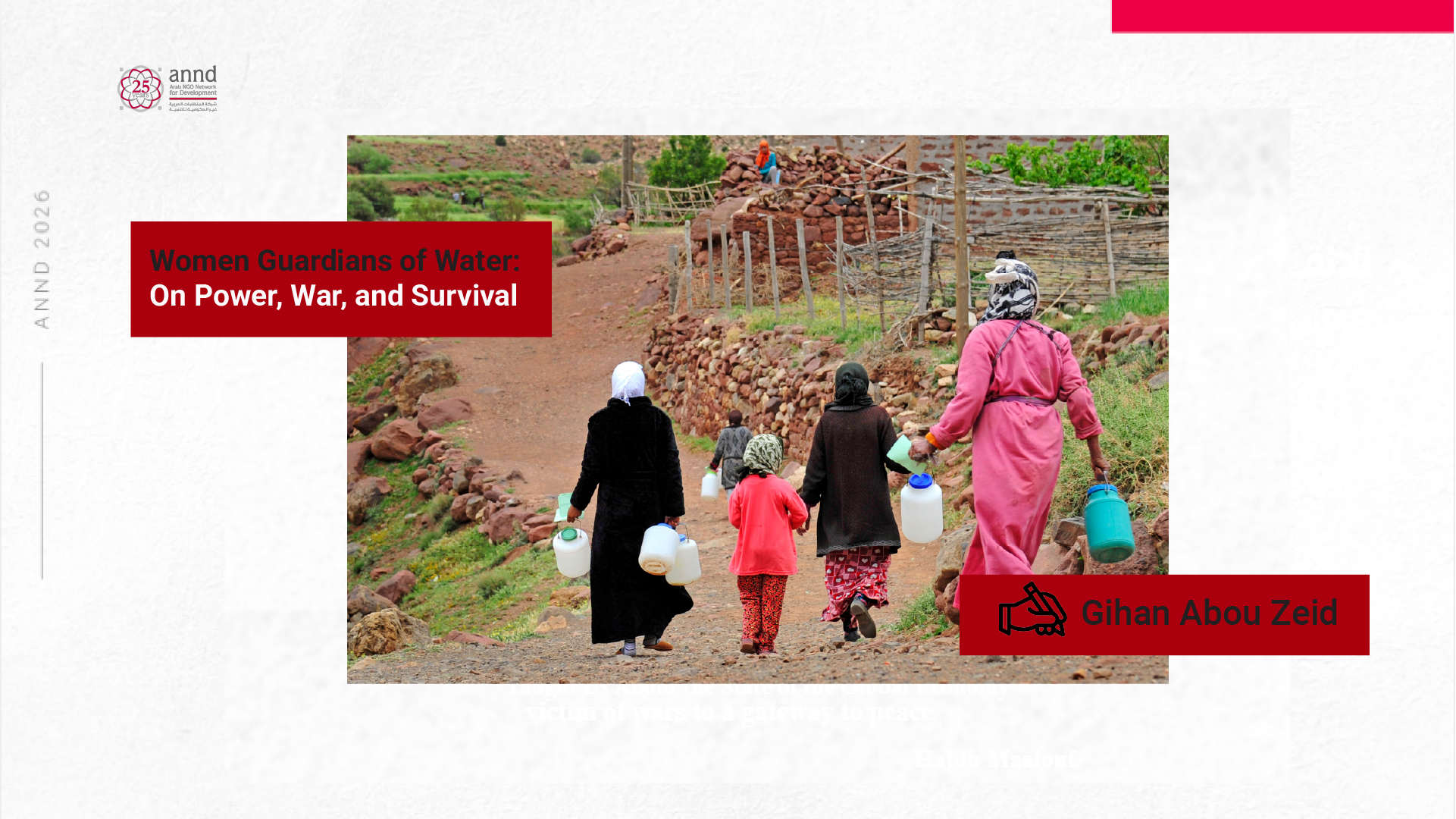
When one of the women of Al-Chibayish held her first reed stalk in her hands after many years, she was not learning a new craft. She was trying to reclaim a part of her life. She sat beside older women from the generation whose fingers still remembered the old movements of reed weaving. They watched her attempts patiently and corrected her with a smile. The woman lifted the stalks slightly and said, as though speaking more to herself than to those around her: “My mother taught me this craft. It was part of our lives, but we stopped because the materials became scarce.”
Those few words summarize the entire story of the marshes. When water is taken away, resources do not disappear alone. An entire way of life and a social system whose backbone was water also disappear. The marshes were never merely a vast expanse of water, but a complete world around which a way of life took shape: houses built from reeds, mats and baskets woven in homes, buffalo living among the waterways, and skills passed from mothers to daughters just as stories are passed down. Water was more than a natural resource; it was the rhythm by which daily life was organized.
But this rhythm was not broken by nature. It was broken by a political decision that changed the course of life as a whole.
The drought that struck the marshes in the 1990s was not a natural drought, but a systematic drying process that targeted both the place and those who lived there. The water disappeared, and with it the reeds, the buffalo, livelihoods, and memory.
From the Marshes to a Wider Regional Pattern
What happened in the marshes is only one manifestation of a broader political structure that is reshaping people’s relationship with water across the region. When water is transformed from a condition for life into an instrument of power, the stories begin to resemble one another regardless of geography: the protests in Figuig, the depletion of Zagora, women’s committees in Yemen, and the systematic deprivation of water in Palestine. At this point, it becomes necessary to move from recounting events to analysing the structure that produces them.
From this perspective, the marshes can no longer be read as a local story, but as part of a regional pattern in which water is taken away and decision-making is centralized, while women bear the greatest burden. The story that begins with a woman trying to recover a forgotten skill ends with a political reality that places women on the front line of the crisis and on the last line of decision-making.
“When water is transformed from a condition for life into an instrument of power, the stories begin to resemble one another regardless of geography.”
The Historical Roots of Water Centralization
To understand this structure, it is not enough to look only at the present moment. The pattern repeated today in the marshes, Figuig, Zagora, Yemen, and Palestine has much deeper roots, extending back to the moment when Arab societies’ relationship with water first changed. Before the establishment of the modern state, Arab societies developed precise local systems for managing water, based on knowledge of place and a social balance that preserved the resource across generations. Colonialism, however, radically redrew this relationship.
In Morocco, colonialism dismantled the khettara systems that distributed water according to precise customary rules. In Palestine, the British administration reformulated water and land ownership laws in ways that left long-lasting effects on access to resources. In Iraq, the aquatic environment was later transformed into an instrument of political punishment, with the drying of the marshes in the 1990s serving as a stark example of the use of water as a means of controlling an entire community.
After independence, Arab states inherited modern centralized institutions that regarded water management as part of the state-building project. Water networks, dams, and irrigation systems expanded, but this expansion carried a clear paradox: the more centralized the state became, the more local participation declined. Decisions concerning water began to be made in centres far removed from the villages and oases that would bear their consequences, while the role of communities that had managed water through inherited knowledge diminished. Water management thus passed from the hands of those who knew it and lived with it into the hands of those who saw it as a figure in a report or an item in a budget.
Structural Adjustment and the Commodification of Water
Then came a new phase in the 1980s and 1990s, when the region entered the cycle of structural adjustment and conditional lending. Recommendations by the World Bank and the International Monetary Fund were linked to reducing public spending, privatizing services, introducing the private sector into water management, pricing water according to its real cost, and linking access to water to the ability to pay. These policies were presented as “reform” and efficiency, but in reality they redefined water from a condition for life into a commodity and transferred responsibility for adapting to scarcity from the state to households, and from households specifically to women.
Women at the Heart of the Crisis
This structural transformation is what places women at the heart of the crisis. When tariffs rise, networks collapse, or services are privatized, the effects do not appear only in economic indicators, but also in the hours of daily labour taken from the lives of women and girls. In Yemen, women spend long hours travelling to collect water, exposed to harassment and violence in conflict areas. In rural Morocco, girls are withdrawn from school to secure water for their families. In Gaza, every water point becomes a daily battle amid the destruction of more than 85 per cent of water and sanitation infrastructure. This is what the literature calls “invisible embodied labour”: labour that does not appear in statistics because it is performed by those who have no voice in shaping them.
The crisis does not stop at the tax imposed on time and the body, but extends to what may be called “accumulated structural violence.” In Wadi Al-Rumman in Morocco, a woman recounts that water scarcity drove her husband to migrate and that she became alienated from her own body because of the lack of water. This led to violence within the family and pushed her to marry off her fifteen-year-old daughter as a way out of a similar fate. In Yemen, international organizations have documented women’s exposure to sexual violence during journeys to collect water. These stories reveal that water scarcity is not merely a technical problem, but a link in a causal chain that produces and reproduces violence.
From Suffering to Resistance
Yet women do not remain within the boundaries of suffering. They create their own forms of resistance. In Figuig, women took to the streets wearing the white haik to protest the transfer of water management from a collective customary system to a government company. Their protest was not symbolic; it was a declaration that they possessed knowledge of water that cannot be acquired from engineering reports. They know when it arrives and when it becomes scarce, how shares are distributed fairly, and how disputes are resolved before they turn into conflicts. Their protest was a defence of a centuries-old knowledge system and of the community’s right to determine the fate of its resource.
Zagora: Resisting Groundwater Depletion
In Zagora, when watermelon farming expanded across thirsty land, residents protested, with women at the forefront of demands to halt the depletion of groundwater. It is true that the temporary ban on watermelon cultivation in 2024 stopped the activity, but it did not change the economic conditions that had produced it, nor did it confront the major investors who reap profits while villages bear the cost of drought. Nevertheless, the protest was a declaration that society is capable of resisting policies that redistribute resources at its expense.
Yemen: Women as Actual Managers of the Resource
In Yemen, when the state and electricity were absent, women took over management themselves. Women’s committees were formed in villages in Taiz, Al-Hudaydah, and Hajjah to organize turns, determine shares, and install solar-powered pumps. These initiatives did not end thirst, but they redefined women’s role from recipients of assistance to actual managers of the resource and creators of local alternatives in the face of state collapse.
The Marshes: Preserving Environmental Knowledge
In the marshes, women are reclaiming their traditional skills in reed weaving and dairy production, not merely as crafts, but as resistance to a knowledge system that is disappearing. When a woman returns to reeds, she does not return merely to a material, but to a relationship with place and to a history of environmental knowledge that resisted drying and marginalization.
Women as Actors Rather Than Victims
These examples reveal that women do not only bear the burden of the crisis, but also create multiple strategies of resistance: collective protest, local organization, daily adaptation, and the preservation of environmental knowledge. These forms of resistance redefine water as a social relationship rather than an economic commodity, and redefine women as actors rather than victims.
The Water Crisis Is a Crisis of Power
What connects the marshes, Figuig, Zagora, Yemen, and Palestine is not drought alone, war alone, or climate change alone, but one political reality: the water crisis is a crisis of power. When decision-making is taken away from communities, and when policies are formulated under the pressure of old colonialism or the modern World Bank, water is transformed from a resource for life into a tool that determines who is able to live with dignity and who is asked to make do with what remains.
At the heart of this equation stand women, not because they are the weakest, but because they bear the greatest burden of the crisis and possess the greatest capacity to resist it.
Recent publications
What Are the Impacts of War on Energy Security? And Could It Accelerate the Energy Transition?