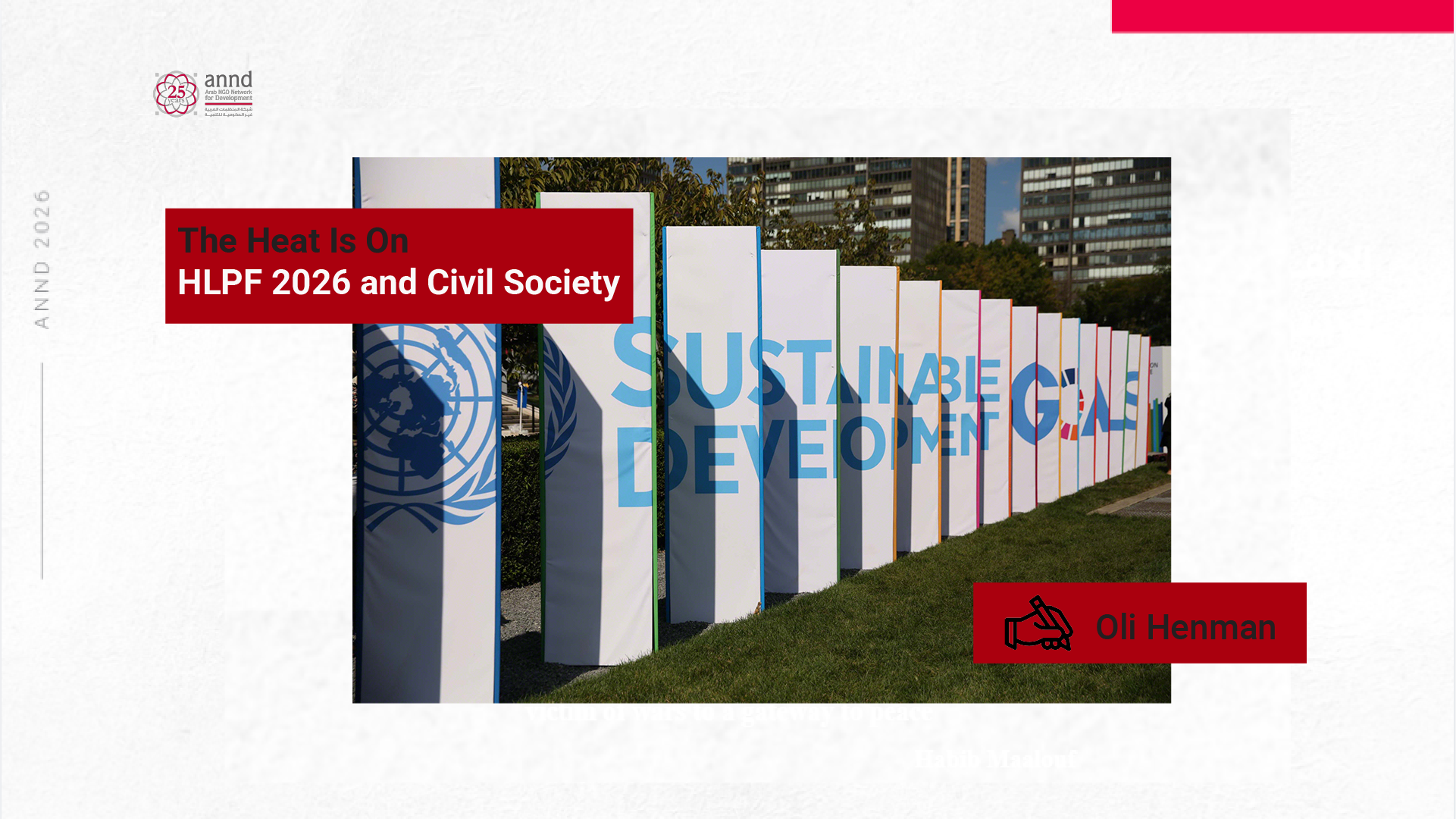
Oli Henman
The heat is on!
In this contribution, Oli Henman, Global Coordinator of Action for Sustainable Development and Co-Chair of the UN Major Groups and other Stakeholders, reflects on the 2026 High-Level Political Forum against a backdrop of climate crises, geopolitical tensions, declining development assistance and growing restrictions on civic space. He highlights both the encouraging signs of international cooperation around renewable energy, localisation and Voluntary National Reviews, and the persistent gaps in addressing inequality, youth opportunities and sustainable development. His reflections also underline the essential role of civil society in defending meaningful participation and strengthening multilateral cooperation at a time when international solidarity is under growing pressure. Looking ahead to 2030 and the emerging post-2030 agenda, Henman calls for stronger alliances within civil society and greater collective action to ensure that local voices and community knowledge shape global development priorities.
This year’s HLPF took place against a backdrop of ever increasing temperatures in the northern hemisphere with wildfires raging across North America and many parts of Europe, while extreme heat in India reached new heights. It is an increasingly challenging picture and the reality of climate change is having major impacts. At the same time, we cannot ignore the increasing geopolitical tensions between the US, Russia, China and the growing conflicts in the Middle East and Iran.
These interlocking challenges of climate change, military conflict and resource competition are having a direct impact on the reality of international cooperation. The budget for international development is being drastically reduced around the world in favour of military spending, we heard in the annual Secretary-General’s Report on Sustainable Development that ODA has dropped by 23% in just one year globally; while at the same time the need for cooperation has never been greater.
The first week of the HLPF focused on the key SDGs under review and there were some noticeable signs of collaboration on major issues such as access to clean water (SDG 6) and accessible affordable renewable energy (SDG 7). The shift to renewable energy in particular, seems to be progressing more quickly than had previously been expected and many countries stepped forward to highlight their movement towards solar and wind power as well as increasing access to battery storage.
During the second week, it was encouraging to see commitments from a number of key countries reporting on the Voluntary National Reviews . Many crucial countries came back with detailed reviews and specific commitments building on national dialogues with civil society and local authorities, such as Brazil, Norway, Switzerland, Tanzania, Cameroon and Jamaica. A key aspect highlighted by many countries is the shift towards more localised development and the opportunity to develop Voluntary Local Reviews and local action plans.
However, overall progress remains slow and there have been major increases in inequality and significant reductions in economic opportunities for young people, while civic space is facing increasing restrictions in many countries, across Latin America, Africa and Asia as well as in the United States.
In the face of this challenging picture, the role of civil society is more important than ever and there were many key moments to bring together stakeholders both inside and outside the Forum.
The NGO Major Group plays a key role in the engagement process with the Major Groups & other Stakeholders and there were many influential events. Here are a few highlights:
We The Peoples: The Future of Multilateralism
The UN Secretary-General Antonio Guterres joined a very candid two hour dialogue with many diverse stakeholder representatives in the Trusteeship Council, he discussed how to strengthen the role of civil society at the UN, including ways to deepen the regional and thematic dimensions as well as key mechanisms to embed meaningful participation. Watch this insightful dialogue here .
Strengthening alliances for SDG implementation: stakeholder engagement for the 2030 Agenda
In the annual stakeholder session in the plenary of the HLPF, there was a timely opportunity to hear from a panel which included USG for Policy, Guy Ryder and ASG Claudia Fuentes Julio of OHCHR in a dialogue with stakeholders and member states on the importance of building stronger alliances for SDG implementation. You can watch the plenary session here .
The Future of Multilateralism: Strategic Planning Towards Post-2030, Weekend Workshop
Over the weekend on Sunday 12th July, over 100 participants from the Major Groups & other Stakeholders from approximately 50 countries joined the annual civil society workshop. This year’s theme was strategic planning for the coming years towards 2030 and beyond. Participants considered ways that we can work together to shape the process and begin to consider next steps for joint action over coming years. You can read the notes here .
Shift the Power for SDG Delivery
In this dialogue, co-hosted by Action for Sustainable Development with CIVICUS and UN Foundation at the Ford Foundation, we considered how locally-led development can enable better targeting of limited resources and how approaches that value community knowledge can ensure more effective action towards sustainable development. Watch this session here .
The coming year will mark a crucial reflection point as we consider the strengths and also limitations of the current agenda, accelerate action towards 2030 and start to look at the next cycle. It will be essential that civil society groups work together to share clear messages during the preparation for the SDG Summit in 2027 and the beginning of the process to look beyond 2030. There will be many opportunities for joint work and co-design of joint messages and we look forward to strong collaboration!
Recent publications
From the Devastation of War to the Breakdown of Public Administration: How Were Lebanon’s State Institutions Depleted?