Morocco in the Face of Climate Change
Kamal Lahbib
Editorial Summary: Kamal Lahbib examines the challenges of climate change in Morocco, focusing on worsening water stress and the country's proximity to the absolute water scarcity threshold. He reviews national adaptation and decarbonization strategies and Morocco's Nationally Determined Contribution (NDC 3.0), highlighting the structural, financial and institutional obstacles to implementation and the role of civil society and social movements in advancing climate and social justice.
Water Stress: Morocco on the Brink of Absolute Scarcity
Although Morocco is considered a country with low greenhouse gas emissions, it remains highly vulnerable to the impacts of climate change. Morocco's Fifth National Communication (CN5) points to projections of a drier climate by 2050. At the same time, annual precipitation is expected to decline throughout the country, generally by between 5% and 15%, and by as much as 20% in certain regions.
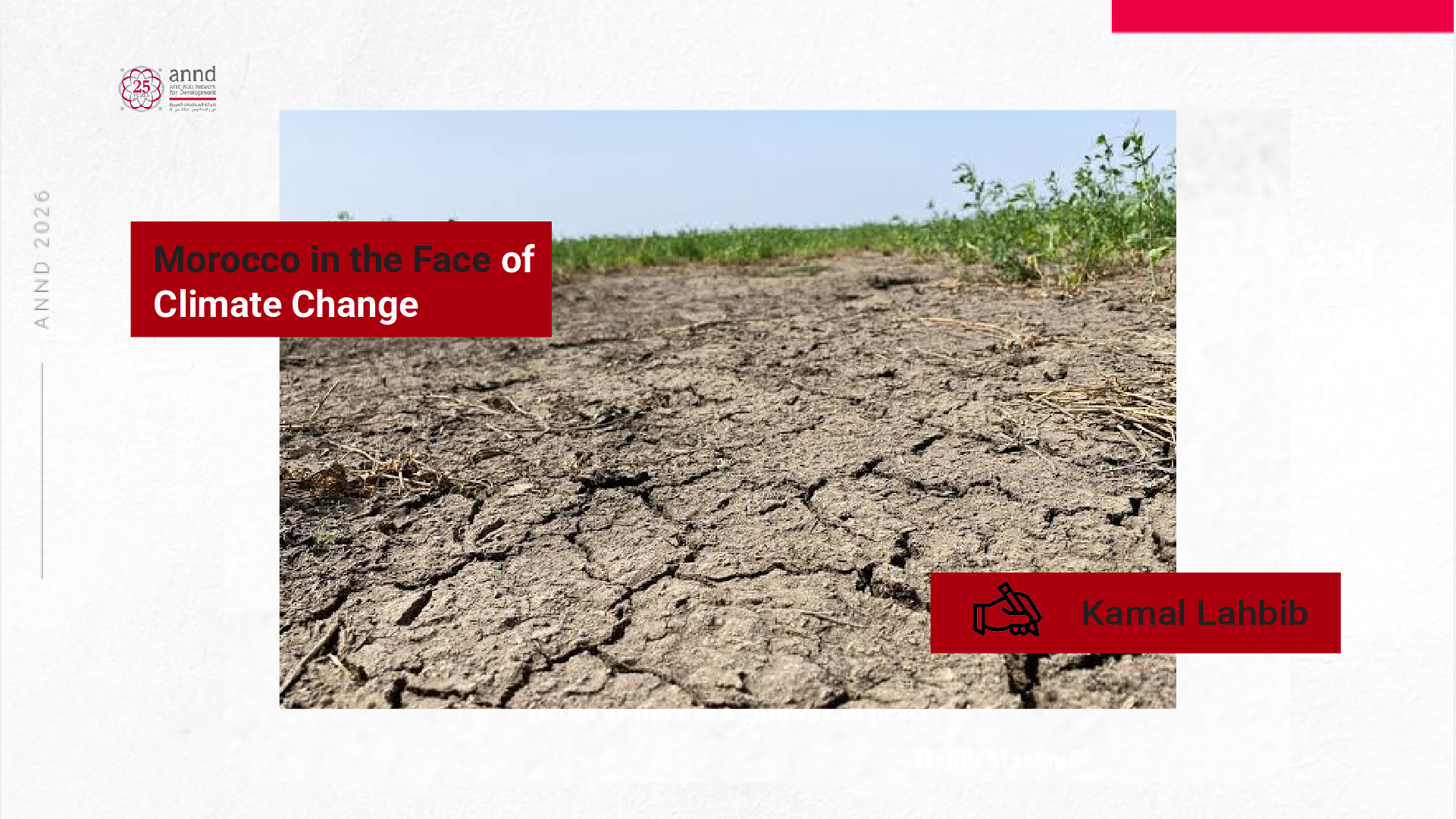
These developments lead to the depletion of water resources, increased variability in rainy seasons, and greater vulnerability to periods of drought. For example, 2023 was the driest year in at least eight decades, with a recorded rainfall deficit estimated at around 48%. This situation exacerbates already alarming water stress. Renewable water resources have declined from 2,560 cubic metres per capita to approximately 620 cubic metres over the past six decades (1960–2025), placing the country at a highly critical level, very close to the absolute scarcity threshold of 500 cubic metres per capita. This situation leads to declining agricultural yields, particularly cereals and vegetables, with losses potentially ranging between 40% and 70%. It also threatens food security and exacerbates social tensions over water distribution. These tensions are intensified by the degradation and depletion of groundwater resources, as well as the overexploitation of dam water, within an agricultural model primarily oriented towards exports, making desalination an indispensable option.
These changes are reflected in the increasing frequency and intensity of heatwaves, worsening forest fires, intensified heat stress, and growing pressure on water resources. Given the severity and high costs of these impacts, adaptation has become a strategic priority of the highest order. In this regard, Morocco reaffirms its determination to contribute effectively to the global response to climate change within the framework of sustainable development and poverty reduction.
The Decarbonization Strategy: An Ambitious Project with a 2035 Horizon
In this context, Morocco's national climate change policy derives its institutional foundation from the National Sustainable Development Strategy (SNDD 2035), which aims to promote balanced and sustainable development in line with the Sustainable Development Goals (SDGs 2030), the New Development Model (NMD 2035), and the national roadmap towards a low-carbon economy by 2050.
This strategy covers six major areas of transformation directly related to climate issues: water security, energy and food security, the development of a competitive low-carbon economy, and the enhancement of natural resources and ecosystems and their resilience to climate change. Alongside the National Sustainable Development Strategy (SNDD), Morocco's policy is reflected in other strategic documents, notably the National Climate Plan (PCN), the National Strategic Adaptation Plan (PNSA), the Nationally Determined Contribution (NDC), specific sectoral strategies, territorial climate plans and regional adaptation plans.
The overarching objective is to make the national territory more resilient to climate change while ensuring the transition towards a low-carbon economy.
Morocco's Nationally Determined Contribution 3.0 (2026–2035)
With the aim of strengthening the implementation of its climate policy and raising its level of ambition, Morocco embarked on the preparation of its Nationally Determined Contribution 3.0 (NDC 3.0), adopting a participatory and inclusive approach. This process was accompanied by the National Commission on Climate Change and Biodiversity, which examined and approved the outcomes of the contribution.
NDC 3.0 reflects considerable ambition compared with the previous version (NDC 2.0), published in 2021, through the inclusion of new sectors and areas, including infrastructure, transport and biodiversity.
In line with the recommendations of the first Global Stocktake of 2023, which call for tripling global renewable energy capacity by 2030, doubling the rate of energy efficiency improvements, and gradually reducing the production and use of coal, which currently accounts for 60% of energy production, NDC 3.0 represents the highest possible level of ambition. Taking national circumstances into account, it establishes implementation targets and measures that adhere to the principle of common but differentiated responsibilities and respective capabilities of each country.
Regarding national mitigation potential, NDC 3.0 aims to reduce greenhouse gas emissions by 53% by 2035, compared with the 45.5% target established in the previous version (NDC 2.0) for 2030. This includes an unconditional reduction of 21.6% by 2035, to be implemented through secured financial resources aligned with national planning. Similarly, NDC 3.0 includes a conditional emissions reduction target of 31.4% by 2035, the achievement of which depends on the provision of the necessary international support. This contribution also provided an opportunity to improve the structuring of adaptation projects and strengthen resilience across multiple sectors.
Furthermore, given the country's vulnerability to the impacts of climate change, NDC 3.0 strengthens efforts related to early warning, climate risk prevention and adaptation, with the aim of reducing the losses and damages that the country is already experiencing.
This mechanism includes a territorial implementation plan aimed at involving local authorities and local stakeholders and embedding climate transformation throughout the country.
NDC 3.0 also attaches considerable importance to the social dimension and promises a just and inclusive transition by integrating the principles of equity, gender equality and the promotion of employment opportunities. Its commitment extends beyond ambitions to reduce greenhouse gas emissions, adapt to climate change and strengthen resilience. It also encompasses social justice and equity, ensuring that every citizen and every region benefits from the positive impacts of this action.
This ambition is commendable, but it faces structural obstacles.
• Financial constraints;
• Limited convergence between public policies;
• Restrictions on freedoms;
• Violations of the Constitution, particularly regarding access to information;
• Non-compliance with Article 13 of the Constitution, which stipulates that public authorities shall establish consultation bodies to involve various social actors in the preparation, activation, implementation and evaluation of public policies.
A report published in 2005, marking fifty years of human development, made the bitter observation: “Our country often appears to be a country of unfinished projects. How many reform projects, initiatives and strategies in various fields have remained merely ink on paper?”1
The Future Is Built, and a Better Future Is Possible
In this context, democratic civil society and social movements are struggling to achieve climate and social justice through:
• Putting an end to the overexploitation of natural resources;
• Exerting pressure for the complete phase-out of fossil fuels over the next two decades;
• Ending land grabbing that violates the rights of Indigenous peoples;
• Establishing mechanisms for popular (citizen) oversight of the economy, production and consumption;
• Mobilizing to achieve food and energy sovereignty;
• Expanding and strengthening the movement demanding payment of compensation owed under the concept of climate debt;
• Working to ensure that climate crimes are subject to judicial accountability and advocating for national legislation that protects ecosystems from predators and the greed of unbridled capitalism.
1. General Report, p. 84. This report was published in 2005, on the eve of the fiftieth anniversary of independence, under the title 50 Years of Human Development in Morocco and Prospects for 2025, commonly referred to as RDH50. The report remains highly relevant, as most of its recommendations have remained on paper. The project was conducted in accordance with the principles of participation and scientific and editorial independence, involving more than one hundred national experts and professionals from academia, public administration and civil society. The complete report is available through the Abhatoo platform under the title 50 Years of Human Development and Prospects for 2025: Report on Morocco's Prospects for 2025 – Towards a High Level of Human Development.
Disclaimer: The views and opinions expressed in this article are those of the author and do not necessarily reflect the official position of the Arab NGO Network for Development (ANND).
Recent publications