From Local Action to Global Advocacy | HLPF 2026 & Egypt - Samira Rashwan & Basmala Tamer
From Local Action to Global Advocacy: Reflections on the 2026 HLPF and Egypt’s 4th VNR
By Samira Rashwan & Basmala Tamer
This contribution brings us reflections from two young Egyptian women who participated for the first time in the 2026 High-Level Political Forum (HLPF) in New York. Their experience offers a valuable perspective on the opportunities and limitations of civil society and youth participation in global policy spaces, as well as the importance of stronger coordination before and after such forums. Drawing on their engagement with Egypt’s Fourth Voluntary National Review, the authors also provide a critical assessment of the gap between official narratives of progress and the socioeconomic realities facing women and youth. Their reflections highlight the need to move from consultation to meaningful participation and from global commitments to sustained national and regional accountability. We are pleased to share this contribution as an important reflection on how young voices from the Arab region can help shape a more inclusive and responsive multilateral system.
Introduction: Claiming Space as Young Arab Women in Global Policy
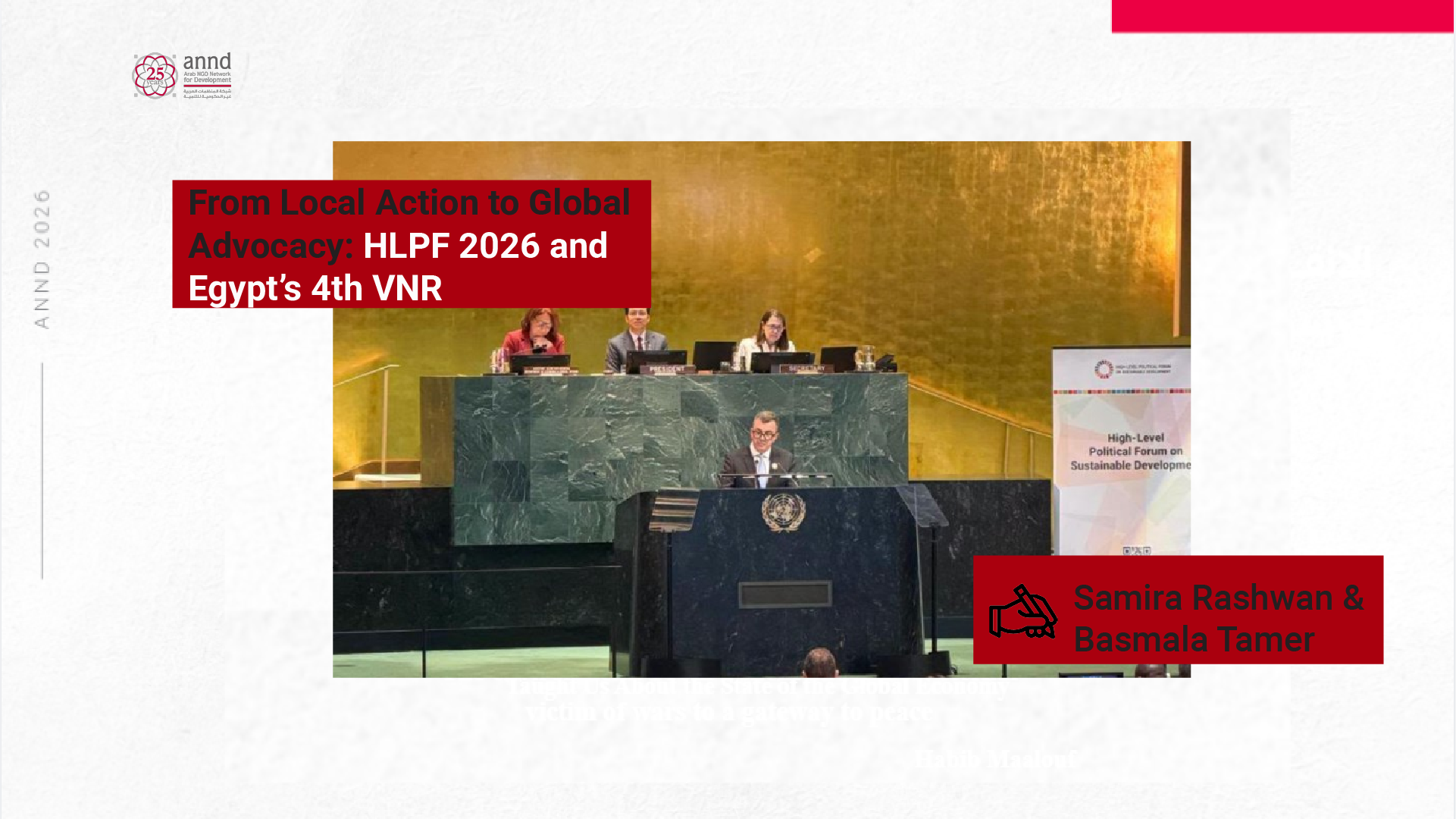
Stepping into the United Nations Headquarters in New York this July for the 2026 High-Level Political Forum (HLPF) was a significant milestone. For both of us, the founder of an emerging think-tank and a researcher from Egypt, navigating the complex environment of global policymaking highlighted the responsibility to bridge the gap between high-level international dialogues on the Sustainable Development Goals (SDGs) and the grounded realities we work to address in our region.
Although Samira is a policy expert with prior experience at various UN gatherings, attending the HLPF for the first time marked a unique milestone. Her presence at the HLPF built upon her academic studies at Ewha Womans University in South Korea, where she extensively researched the mechanics of the Forum. Translating this specialized knowledge from theory to practice by actively engaging to discuss the future of Egypt realized a core vision behind the Strategic Priorities Hub (SPH), a think-tank she founded in 2023 to generate scientific, evidence-based public policy solutions.
For Basmala, stepping into the HLPF arena for the first time was a profound eye-opener and a defining catalyst for her career. The experience helped in transforming abstract international relations into a practical vantage point, allowing her to witness firsthand how global policymaking is evolving on the ground, and where critical gaps still remain. More than just an observational milestone, this inaugural participation equipped her with actionable diplomatic insights which will contribute to elevating her professional commitment to driving systemic, grassroots-informed change.
We extend our deepest gratitude to the Arab NGO Network for Development (ANND) for facilitating our participation, ensuring that critical regional civil society voices were powerfully represented on this global stage.
However, stepping into a multilateral arena as massive as the HLPF can also be deeply overwhelming. Between the labyrinthine corridors of the UN Headquarters, the sheer volume of parallel side events, and the dense diplomatic jargon, it is easy for civil society representatives, especially young first-time attendees, to feel sidelined or lost in the noise.
Our observations highlighted practical challenges regarding inclusion. Despite the HLPF’s multi-stakeholder approach, restricted civil society access to some of the events limited comprehensive engagement. Even in accessible sessions like the general debates, discussions were primarily led by state representatives and international institutions. While Major Groups are allotted formal speaking slots during Voluntary National Reviews, outside of these highly structured moments, youth and civil society delegates were largely relegated to observational roles, with few opportunities to engage in open dialogue or share alternative perspectives. This dynamic contrasted noticeably with more inclusive approaches; the Second World Summit for Social Development in Doha, for example, serves as a model of a more participatory environment to an extent. Finally, these barriers were occasionally compounded by logistical issues, such as intermittent shortages of translation headsets, which hindered not only active participation, but even the basic ability to listen to and follow the proceedings in the rooms.
Navigating this intense and structurally challenging ecosystem underscored the practical value of strategic coordination among advocates. Specifically, it highlighted the indispensable role of the briefing meetings that took place with the Major Groups chairs every morning.
Attending these briefings, one of which we had the opportunity to join, served as a crucial grounding mechanism. They acted as a daily compass, setting the tone for the day's negotiations, distilling complex agendas into actionable information, and helping civil society organizations figure out exactly how to navigate the space to maximize the benefit of their attendance. Experiencing the sheer utility of this coordination prompted a vital question: how can we replicate and elevate these mechanisms? The solidarity and alignment fostered in these morning sessions should not be confined to a two-week event in New York. To truly elevate our impact, we must decentralize this model, replicating these strategic, unifying practices at regional and national levels to ensure advocates are fully prepared, aligned, and confident before they ever step onto the global stage.
Equipped with these daily insights, a major objective for us at the HLPF was helping to draft, and ultimately deliver, the official NGO Major Group statement responding to Egypt’s 4th Voluntary National Review (VNR). This achievement demonstrated the importance of the collaboration that took place between civil society organizations during the drafting process. Moving forward, we want to see even wider engagement for NGOs in these drafting processes. We believe that what made this process effective was how the involved NGOs brought different, complementary perspectives to the table. The resulting collaboration led the Major Group representatives to deem our statement one of the most comprehensive and well-structured ones delivered at the Forum. Infused with the perspectives of SPH’s youth, our input to this joint effort was informed by grounded, evidence-based analysis and prior dialogues with policymakers, including discussions with former Minister H.E. Dr. Ahmed Darwish on Egypt's sustainable development strategic priorities.
An Analysis of Egypt’s 4th VNR
During the VNR presentation at the HLPF, witnessing the Egyptian Minister’s openness to engage in an interactive Q&A and direct dialogue with civil society was a positive step. It proved that when youth and civil society are well-prepared, our voices can bridge the gap and participate in the narrative in these high-level spaces. However, delivering our statement also required providing an objective, structural critique.
In its 4th VNR, the Egyptian government presented a narrative focused on national resilience, spotlighting infrastructural megaprojects, macroeconomic strategies, and localization efforts like the Hayat Karima (Decent Life) initiative. While acknowledging state-led infrastructural strides is important, the role of civil society at the HLPF is to provide a grounded reality check. Drawing on SPH Synthesis and Assessment Reports, applying an intersectional youth, gender, and human rights lens revealed several bottlenecks:
Conclusion: Charting the Course for Post-HLPF Engagement
As the discussions at the 2026 HLPF made clear, crossing the halfway point of the Sustainable Development Goals requires the global focus to shift from repetitive reporting to accelerated action and the co-creation of the post-2030 framework. This forward-looking approach aligns with SPH’s ethos. To ensure our generation's vision shapes tomorrow's multilateralism, a momentum we carried directly from the HLPF and across other milestones like the UN Summit of the Future, SPH has launched a dedicated policy paper exploring the "Beyond SDGs" landscape, defining concrete goals based on the lessons we are learning today.
Translating this global experience into localized learning was also an immediate priority upon our return. We designed a dedicated training session about the HLPF for our group of current interns, who are embarking on a developmental journey with us from July to September. We created a simulation model illustrating how VNRs are delivered and recreating the interactive sessions of the HLPF on VNRs. By allowing our interns to navigate these scenarios, we aim to demystify high-level spaces and equip the next generation of Egyptian policy researchers with practical tools. To scale this institutional knowledge, SPH envisions creating open-source "Navigation Playbooks" for multilateral spaces, practical survival guides that decode UN jargon, map out the Major Group ecosystems, and provide actionable tactical advice for first-time attendees from the Global South.
To ensure the commitments discussed at the HLPF translate into reality in Egypt and the wider Arab region, our approach to engagement must structurally evolve. We present the following recommendations to ensure a transition from token participation to meaningful, replicable impact:
Recommendations for Civil Society Engagement:
Recommendations for Youth Engagement:
Leaving the HLPF, we carry with us a clear sense of purpose. The structural challenges we face in the Arab region are complex, but the collective efforts of youth, women, and networks like ANND provide a strong foundation for progress. Together, we will continue to claim our space, suggest innovative solutions, and drive the systemic reform required to ensure that no one is left behind.
References
1 Egypt, Ministry of Planning, Economic Development and International Cooperation, Egypt's 2026 Voluntary National Review (Cairo: Government of Egypt, 2026), p. 93, https://hlpf.un.org/sites/default/files/vnrs/2026/VNR%202026%20Egypt%20Report_0.pdf
2 Ibid, p.133
3 Ibid, p.133
4 Ibid, p.133
5 Ibid, p.133
6 Ibid, p.133
7 Ibid, pp. 93-95
Recent publications

Resilient for Whom? The IMF's October 2026 Outlook and the Poor of MENA - Khalil Gebara