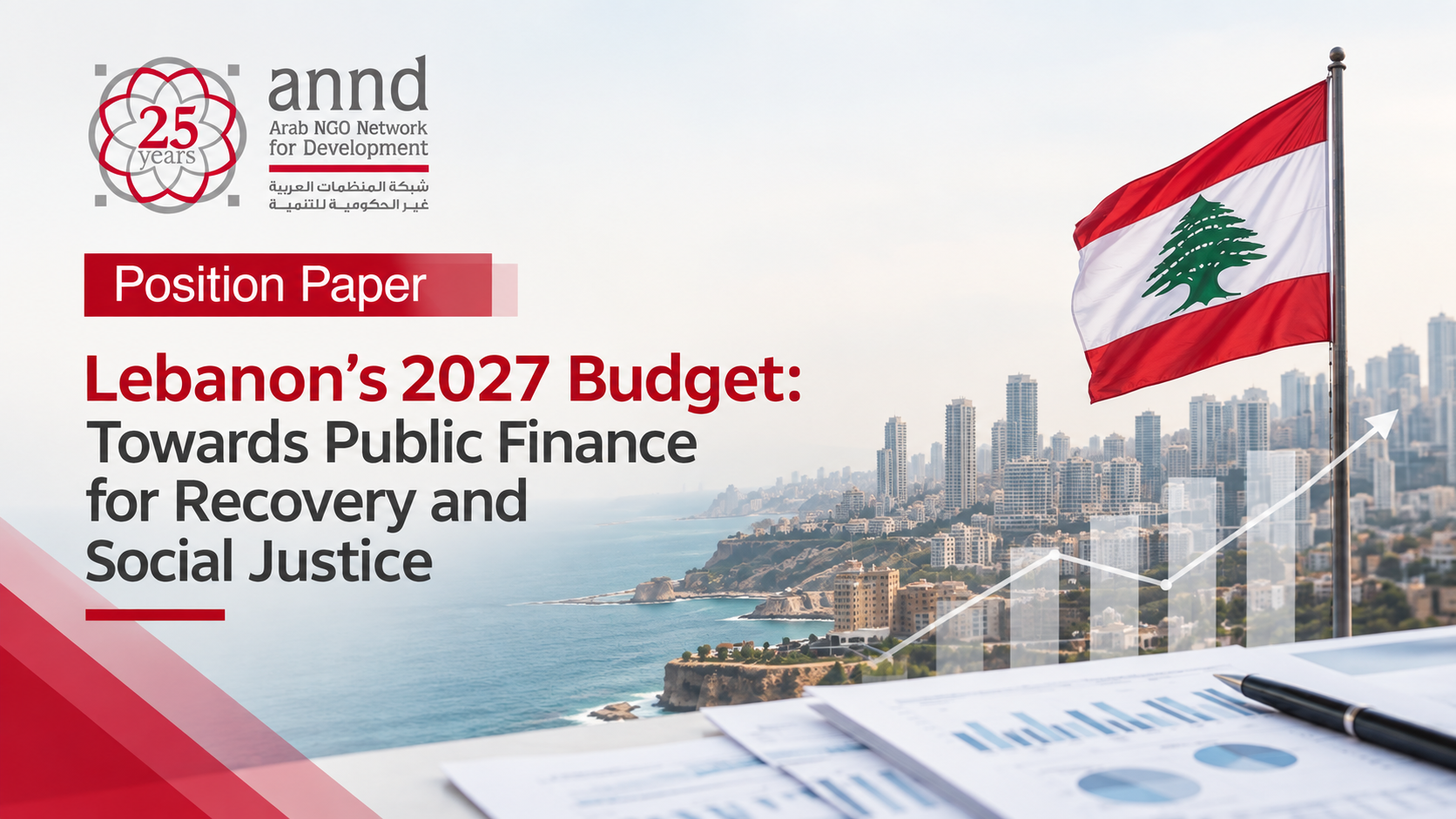
ANND's Position Paper: Lebanon’s 2027 Budget: Towards Public Finance for Recovery and Social Justice

Lebanon’s 2027 Budget: Towards Public Finance for Recovery and Social Justice
The Arab NGO Network for Development (ANND) has released a new position paper examining Lebanon’s 2027 Draft Budget at a critical stage in the country’s economic and financial recovery. Years after the economic and financial collapse, Lebanon continues to face declining purchasing power, growing social needs, weakened public services and infrastructure, and major challenges in rebuilding state institutions and restoring sustainable public finances.
The paper argues that the budget should be assessed not simply according to whether projected revenues and expenditures appear balanced, but according to whether it contributes to a broader economic and social recovery strategy. ANND stresses that an accounting balance alone cannot demonstrate fiscal sustainability while fundamental issues—including public debt, accumulated state liabilities, public-sector wages, the restructuring of the financial sector, and the rebuilding of public institutions—remain unresolved.
Tax Justice and Public Resource Mobilization
A central concern of the paper is how the state mobilizes resources and how the tax burden is distributed. The 2027 Draft Budget estimates public revenues at approximately LBP 614.9 trillion, of which around LBP 528.2 trillion comes from taxation. The structure of these revenues continues to give considerable weight to taxes associated with consumption.
ANND calls for a gradual shift towards a fairer and more sustainable tax system based on a stronger role for direct and progressive taxation, greater consistency in the treatment of different sources of income and wealth, reduced reliance on consumption-related taxes, stronger action against tax evasion and avoidance, and better integration of economic activities that remain insufficiently covered by the tax system.
The paper also examines the taxation of wealth and property, management of the public maritime domain, environmental taxes and fees, and revenues associated with public assets and natural resources. It calls for greater transparency and accountability in the management of these resources and for a clearer link between the ability to pay and contributions to financing the state.
From Revenue Collection to Recovery
ANND emphasizes that strengthening public finances cannot be reduced to increasing tax collection. The way public resources are spent is equally important. The paper examines the high weight of current expenditure and the relatively limited space available for public investment, while rejecting approaches that seek to address fiscal constraints by reducing essential social spending.
Instead, ANND calls for public investment to be directed towards sectors that can contribute directly to economic and social recovery, including energy and water, transport, health, education, infrastructure, reconstruction, and job creation. Such investment should be based on clear and measurable objectives and a multi-year approach rather than isolated annual decisions.
Social Protection, Transparency and Accountability
The position paper treats social protection as a core function of the state and an integral component of economic policy, rather than simply a temporary response to crises. ANND calls for a sustainable system financed increasingly through domestic public resources and better connected to decent work, public services, health coverage and labour-market policies.
The paper also stresses that rebuilding public finances requires greater transparency and accountability. Parliament, civil society and citizens should be able to understand what resources were budgeted, what was actually spent, how resources were used, and what results were achieved. ANND therefore calls for improved access to financial information, timely completion of final accounts, stronger oversight and evaluation, and a gradual transition towards programme- and performance-based budgeting.
Towards a Budget for Recovery and Social Justice
Ultimately, ANND calls for the 2027 Budget to become part of a broader process of rebuilding Lebanon’s public finances and state institutions. This requires a fairer and more sustainable revenue base, a more equitable distribution of the cost of financing the state, protection of social rights and purchasing power, stronger investment in public services and recovery, and greater transparency in the management of public resources.
Rather than treating the budget as an annual accounting exercise, the paper calls for a medium-term fiscal and economic approach that connects taxation, expenditure, public debt, social protection and public investment to a coherent vision for recovery. In this way, public finance can contribute to rebuilding the relationship between the state and society on the basis of fairness, sustainability, accountability and the effective use of resources for both the economy and people.
Recent publications
Who Enters the Age of Electricity? And Who Pays the Price? - Habib Maalouf