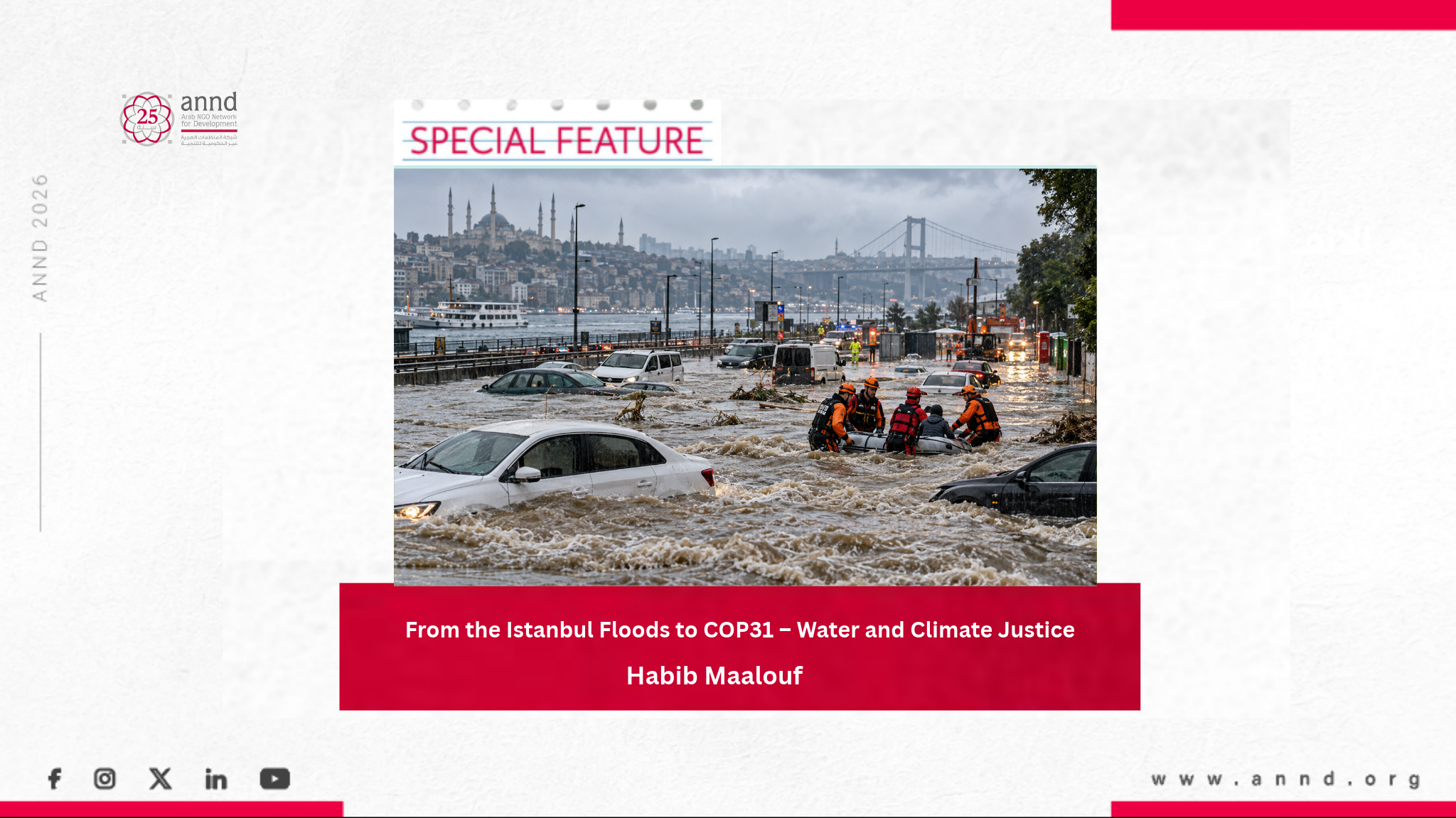
From the Istanbul Floods to COP31: Why Must Water Be at the Heart of Climate Negotiations? - Habib Maalouf

From the Istanbul Floods to COP31: Why Must Water Be at the Heart of Climate Negotiations?
By Habib Maalouf
The floods that struck Istanbul in mid-October 2026 were not merely an isolated climate-related incident, nor can they be explained by heavy rainfall alone. The Beykoz district recorded 277.1 mm of rainfall, according to data reported by the Istanbul Metropolitan Municipality, the highest level recorded at its stations since 1942. The floods caused casualties and widespread damage, inundating roads, tunnels, and homes, and disrupting transportation, among other consequences.
The significance of this event lies not only in the volume of rainfall and the resulting losses, nor in its timing just weeks before Turkey hosts the 31st Conference of the Parties to the United Nations Framework Convention on Climate Change (COP31) in Antalya from 9 to 20 November. Its importance lies in opening the door to a broader discussion about the place of water in climate policies and the relationship between natural phenomena and the ways we manage resources, land, and cities.
How, then, can water become a central issue in climate discussions when its management remains divided among sectors, institutions, and policies that are insufficiently coordinated?
When Rainfall Turns into Disaster
Flooding cannot be considered an unprecedented phenomenon in Istanbul. The city has experienced severe floods in previous years, including in 2009. However, the intensity of the recent rainfall raises renewed questions about cities' preparedness for extreme events and the suitability of urban planning patterns and infrastructure for changing risks.
Heavy rainfall is the immediate cause of flash floods, but the scale of losses is not determined by rainfall volumes alone. It is also influenced by urban expansion, the covering of soil with asphalt and concrete, construction in low-lying areas and natural drainage channels, the efficiency of stormwater drainage networks, and the preparedness of institutions to manage risks.
Climate change adds another dimension, increasing the intensity of extreme precipitation in many regions, although determining its precise contribution to this particular storm would require a dedicated scientific study.
This reveals a paradox worth considering: the water that cities and communities need can become a source of destruction when it exceeds infrastructure capacity, just as its scarcity can threaten life, agriculture, food, and energy.
The problem is not always the presence or absence of water, but rather when it arrives, how much of it there is, where it flows, and how the water cycle is managed to protect the communities that depend on it.
From Floods to Drought: Water at the Heart of the Climate Crisis
The Intergovernmental Panel on Climate Change confirms that global warming affects the water cycle and that flood and drought risks are intensifying in many regions as a result of climate change, alongside multiple social, economic, and urban factors.
Warming affects evaporation, precipitation, soil moisture, and groundwater recharge. It also changes snowfall patterns, the timing of snowmelt, and river flows. These changes are not distributed evenly across regions but interact with the characteristics of watersheds, ecosystems, and land-use patterns.
Yet water is not merely a victim of climate change; it is also a fundamental link in the chain of its impacts on people and nature.
Drought affects crops and food security, increases pressure on groundwater, threatens ecosystems, and raises the cost of providing drinking water and energy. Floods can destroy infrastructure and homes, contaminate water sources, erode soil, and damage crops. Meanwhile, melting glaciers and changing snow cover affect the regularity of river flows and the communities that depend on them, while also contributing to increased runoff and flooding.
The impacts of water extend beyond the environment in its narrow sense to affect the economy, health, migration, and social stability. They also intersect with energy issues, whether through the electricity required for desalination, pumping, and treatment, or through water's role in energy production and cooling industrial facilities, particularly the rapidly expanding artificial intelligence industry.
For this reason, treating water as a sector separate from others fails to reflect the interconnected nature of climate and environmental crises. Water should instead be viewed as one of the central pillars around which climate policies must be integrated.
Are Large Dams Enough to Solve Water Problems?
The Istanbul floods raise questions about the relationship between infrastructure and natural systems. Dams, reservoirs, and engineering structures perform important functions in water storage, irrigation, electricity generation, and the regulation of certain flows, but they do not, on their own, constitute a comprehensive water management strategy.
The Atatürk Dam, for example, is located on the Euphrates River and has no direct connection to the floods affecting Istanbul's streets, since the watersheds involved are different. Nevertheless, the example allows us to raise a broader question about water management choices: Should the success of water policies be measured by the volume of water we can store, or by our ability to manage resources sustainably and protect people from both floods and droughts?
Building a new dam does not necessarily address groundwater depletion or losses in distribution networks, just as storing water does not compensate for the deterioration of natural watersheds or unsustainable land-use patterns. Some large projects may be necessary, but their assessment should include environmental and social impacts, future climate risks, and effects on communities upstream and downstream.
In cities, protecting forests, soils, and wetlands, restoring areas capable of absorbing rainwater, preventing construction in flood channels, and developing drainage and early-warning systems are no less important.
The objective, therefore, is not to make an absolute choice between engineering structures and nature, but to move toward integrated management that combines infrastructure, ecosystem protection, and sound urban planning. Water management does not begin at dams and reservoirs; it begins with the watersheds where water accumulates, the soils that absorb it, the forests that influence its availability and flow, and the cities that receive it. It has therefore become urgent to call for the protection of these watersheds, just as we previously called for the establishment of terrestrial and marine protected areas.
Transboundary Waters: From Managing Resources to Managing Relations Between States
The issue becomes more complex when discussing rivers and groundwater basins that cross political borders. Water does not stop at national boundaries, but decisions concerning its storage, diversion, use, and the timing of its release are subject to national authorities whose economic, technical, and political capacities may differ.
This is particularly evident in basins such as the Tigris and Euphrates, where drinking water, agriculture, and energy needs intersect with decisions about dam construction, storage, changing flows, and climate challenges.
Water security in these basins cannot be understood solely through the quantity of naturally available water. The timing of water flows, the amounts stored, patterns of use, and the extent of cooperation in data exchange and planning all influence communities' capacity to cope with droughts and floods.
Water cooperation thus becomes part of climate change adaptation rather than a separate diplomatic matter. Adaptation within one country may remain limited in effectiveness if its measures transfer risks to another country or to communities with less capacity to protect their rights.
Climate policies should therefore promote data sharing, early-warning systems, joint risk assessments, cooperation in basin management, and consideration of the needs of populations and ecosystems across different parts of these basins.
This does not mean replacing existing legal frameworks and institutions responsible for water with the climate convention, but rather creating integration between them, so that climate risks are not discussed without understanding the decisions governing water, and major water decisions are not made without accounting for the impacts of climate change.
Water Storage and Desalination: Who Bears the Cost?
Water scarcity is driving some countries to expand dam and reservoir construction and drill more wells, while others, particularly in coastal areas, are turning to seawater desalination and the reuse of treated wastewater.
These options, however, do not have equal impacts or costs. Desalination can provide an important resource for areas suffering from chronic water shortages, but it requires energy, investment, and infrastructure, and may have environmental impacts associated with the discharge of concentrated brine. If powered by emissions-intensive energy sources, it may increase the carbon footprint of water supply.
Dams should likewise be assessed according to their impacts on rivers, sediments, ecosystems, and communities, rather than solely by their storage capacity or electricity-generation potential.
This raises a fundamental question: Who chooses these projects, who finances them, who benefits from them, and who bears their environmental, social, and financial costs?
The need for a new project may be genuine, but managing water demand, reducing losses, protecting watersheds and groundwater, improving irrigation efficiency, and reusing treated wastewater may provide less costly alternatives or complementary measures in some cases. Water management choices should therefore undergo comprehensive assessment that considers climate impacts, social needs, fairness in distribution, available alternatives, and the project's long-term effects.
Adaptation does not necessarily mean building more infrastructure. It means choosing appropriate solutions for each basin, region, and community, and comparing their costs, benefits, and future impacts. The most sustainable solution may be a combination of infrastructure, protection of natural systems, and demand management rather than reliance on a single option.
Why Must Water Management Be Included in Climate Negotiations?
This brings us to the heart of the matter.
If water is one of the main areas in which the impacts of climate change are manifested, and if its management affects communities' ability to adapt, it is only logical that it should have a more prominent place in climate negotiations, financing, technology, and international cooperation.
This does not mean that water is entirely absent from these negotiations. It is already addressed in national adaptation plans and numerous initiatives. What is needed, however, is a transition from acknowledging its importance to integrating water management more systematically and coherently into climate policies and their implementation mechanisms.
This requires action along five interconnected pathways:
First: Integrating comprehensive water management into adaptation plans and their financing. The focus should not be limited to securing water supplies, but should also include protecting natural watersheds, improving stormwater drainage, reducing flood and drought risks, and safeguarding groundwater sources.
Second: Assessing major water projects from climate, environmental, and social perspectives. This includes dams, reservoirs, water diversions, and desalination plants, taking into account their transboundary impacts and long-term costs, and comparing alternatives before making investment decisions.
Third: Strengthening climate cooperation in transboundary basins. This can be achieved through data exchange, early-warning systems, joint planning to address droughts and floods, and support for cooperation between institutions responsible for water and climate.
Fourth: Providing financing and technology on fair terms. Water-related adaptation requires technologies for monitoring, management, treatment, reuse, and more efficient desalination, as well as infrastructure capable of withstanding future risks. Technology transfer, however, cannot be achieved merely by making technologies theoretically available. It requires appropriate financing, capacity-building, and conditions that allow developing countries to use and develop these technologies without unsustainable financial burdens.
Fifth: Connecting water with biodiversity, desertification, food security, and energy. Protecting water sources cannot be separated from protecting forests, soils, wetlands, and agricultural systems. Addressing these issues in isolation may produce contradictory solutions or transfer harm from one sector to another.
This integration should not come at the expense of existing commitments under the climate convention, nor should it be reduced to voluntary initiatives lacking financing, implementation, and accountability. What is needed is for attention to water to be reflected in national adaptation plans, risk assessments, financing priorities, technology development, and stronger international cooperation. It also requires revisiting national strategies to prioritize the protection of watersheds and water sources, regulating and rationalizing consumption across all sectors, managing demand, and changing the strategies and rules governing negotiations between countries in light of increasing climate disasters, which make greater cooperation rather than competition imperative.
COP31: An Opportunity to Address Water Through the Lens of Climate Justice
This call takes on particular importance as COP31 approaches in Turkey, at a time when water-related challenges are increasing across large parts of the world, including the Arab region.
Countries in the region face overlapping risks: drought, water scarcity, groundwater depletion, flash floods, ecosystem degradation, and growing reliance on desalination in some countries and the construction of more dams in others. These trends are extremely costly and may have disastrous long-term consequences. Transboundary waters also make water security dependent on regional cooperation and on the ability to respond to climate change without deepening existing inequalities.
Arab civil society should therefore call for water management to receive a more prominent place in climate deliberations and outcomes, as well as in adaptation finance and technology-transfer processes, and advocate for linking it to climate justice, the right to development, and ecosystem protection. This was indeed one of the key demands included in the Arab civil society position paper on COP31 this year.
The objective is not to establish a separate parallel track outside the climate convention, but to strengthen integration between climate action and water policies, and between states' commitments, existing agreements, and regional cooperation.
This includes advocating for recognition of transboundary waters and establishing new principles for managing them that take climate considerations into account. It also involves reconsidering approaches to water storage behind dams, seawater desalination, water reuse, demand regulation, increasing consumption, and the protection of natural watersheds as issues that intersect with adaptation, mitigation, finance, technology, and justice.
Water must move from being a subject raised only when discussing droughts or floods to becoming an integral element in assessing climate policies themselves: How will these policies affect water resources? Who will benefit? Who will bear their costs? Will they strengthen communities' capacity to adapt, or transfer risks elsewhere?
It is also important to distinguish between states' formal commitments under the climate convention and voluntary initiatives that may be launched by the COP presidency. Such initiatives can open new avenues for cooperation, but they cannot substitute for adequate financing or the implementation of existing commitments.
From Controlling Water to Managing the Cycle of Life
Ultimately, the significance of the Istanbul floods does not lie in their providing conclusive evidence of a single climatic cause, but in once again exposing the fragility of the relationship between cities and water, between infrastructure and natural systems, and between local policies and global risks.
Water can become a disaster when it overflows, a crisis when it runs dry, and a source of conflict when it crosses political borders. It may also require new energy sources, financing, and technologies when we resort to storage or desalination. These are not separate problems, but interconnected dimensions of a single question: How do we manage water in a world where the water cycle is changing, while patterns of production, consumption, urban expansion, and water policies continue to shape the distribution of risks and resources?
It is not enough to increase our capacity to store water behind dams, build larger drainage networks, or produce more desalinated water. What is needed is integrated management that begins with protecting watersheds and water sources, takes into account the rights of people and ecosystems, and connects water-related decisions to urban and population planning, agriculture, energy, and cooperation between countries.
Integrating water management into climate negotiations is not merely a technical addition to the agenda, but a political, environmental, and ethical necessity. Water is not simply an economic resource or a technical matter handled by specialized ministries. It is a condition for life, a fundamental right, and a shared resource on which communities' ability to adapt to climate change depends.
There can be no climate justice without water justice, no effective adaptation without sustainable water management, and no genuine climate cooperation without equitable cooperation over resources that cross political borders.
Perhaps this is the question that should reach Antalya as COP31 convenes: not only how we confront climate change, but how we reorganize our relationship with water as a condition for life, a fundamental right, and a shared resource on which the ability of communities and future generations to live in safety and dignity depends.
Recent publications
From the Devastation of War to the Breakdown of Public Administration: How Were Lebanon’s State Institutions Depleted?