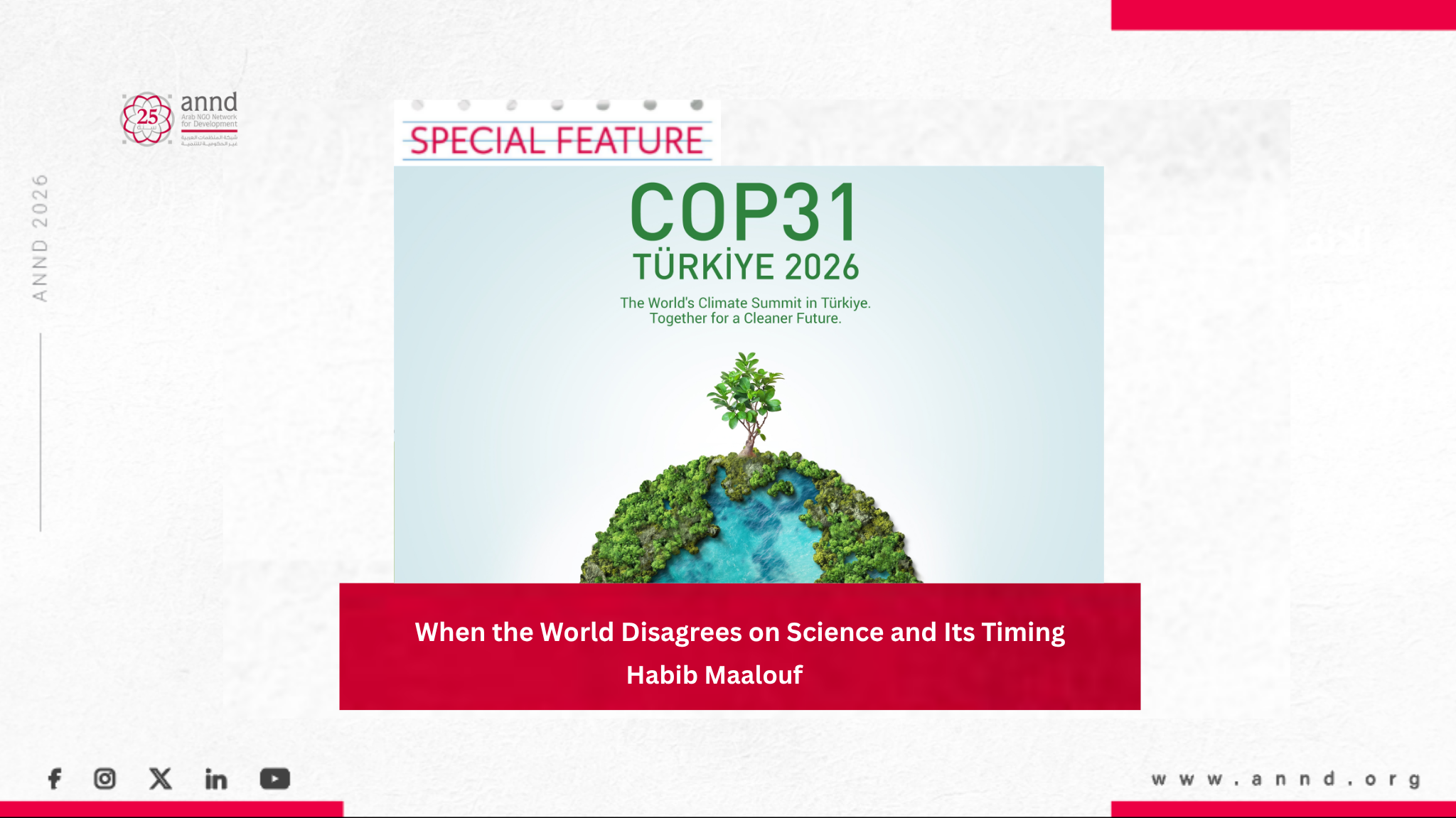
When the World Disagrees on Science and Its Timing
The Deadlock over the Seventh Climate Assessment Report Ahead of COP31 Reveals a Crisis of Trust, Funding, and Justice
By Habib Maalouf
The conclusion of the sixty-fifth session of the Intergovernmental Panel on Climate Change (IPCC), held in Addis Ababa from 12 to 16 October 2026, without an agreement on the timeline for the Seventh Assessment Report (AR7), was not merely an administrative setback within an international scientific institution. For the sixth consecutive time, the disagreement exposed a deeper crisis concerning the relationship between science and politics, equity in the production and funding of climate knowledge, and the international community's ability to provide scientific evidence when it is needed for decision-making.
The significance of this disagreement lies precisely in its timing. The thirty-first Conference of the Parties to the United Nations climate convention (COP31), to be hosted in Antalya in November 2026, will mark the official launch of the second Global Stocktake (GST2) under the Paris Agreement, which is scheduled to conclude at COP33 in 2028. This process is intended to assess collective progress in addressing climate change and help countries strengthen their commitments, actions, and mutual support. The question, therefore, goes beyond technical considerations: What happens when the scientific knowledge intended to help the world measure the gap between its commitments and its actual actions is delayed? Is the disagreement over the timeline a legitimate attempt to ensure broader and fairer participation, or could its continuation deprive negotiations of an essential scientific reference at a critical moment?
From Six Reports to a Battle over the Seventh
The Intergovernmental Panel on Climate Change was established in 1988 at the initiative of the World Meteorological Organization and the United Nations Environment Programme to assess scientific knowledge relating to climate change, its impacts, and options for addressing it. Since its first report in 1990, it has issued six major assessment reports, each of which has played a role in shaping the international response to the climate crisis.
The first report helped launch the negotiations that led to the United Nations Framework Convention on Climate Change in 1992. The second report, published in 1995, provided an important scientific foundation for the negotiations preceding the Kyoto Protocol in 1997. The Sixth Assessment Report, whose Synthesis Report was completed in March 2023, provided the scientific reference for the first Global Stocktake under the Paris Agreement that same year.
The value of these reports lies not only in their contribution to scientific knowledge, but also in their ability to bring together thousands of studies, assess levels of certainty and disagreement, and transform specialised research into a shared reference that governments can draw upon, even when their political and economic interests diverge.
A scientific review published in 2020 demonstrated that most climate models developed between the 1970s and the first decade of this century successfully projected subsequent warming trends, particularly when differences between assumed emissions and actual emissions were taken into account. This does not mean that every previous projection was accurate in every detail, or that climate scenarios are inevitable predictions. Rather, scenarios describe possible pathways depending on emissions, policies, and future conditions. It does mean, however, that the fundamental warnings about global warming were not merely passing speculation.
The deadlock over the seventh report therefore threatens more than the publication date of new documents. It raises questions about the international system's ability to preserve the connection between the accumulation of scientific knowledge and the timing of political decisions.
What Went Wrong in Addis Ababa?
The seventh assessment cycle officially began in 2023 and includes three main reports: the report on the physical science basis of climate change, the report on impacts, adaptation, and vulnerability, and the report on climate change mitigation. The central issue concerns when these reports will be approved, not any scientific disagreement over the reality of climate change.
Some of the proposed timelines aimed to complete all three reports in 2028, making their findings available during the second Global Stocktake or before its conclusion. Other countries, however, pushed for extended deadlines, proposing that one or more reports be delayed until 2029. They argued that additional time was needed to prepare and review the reports and to strengthen the ability of scientists and governments with fewer resources to participate.
According to specialised coverage of the Addis Ababa meeting, China, India, Russia, Saudi Arabia, and Kenya were among the countries calling for more time. Other countries, including small island states, expressed concern that delays could deprive the Global Stocktake of the latest comprehensive scientific reference when it is needed. The meeting ended without agreement on the timeline, following five previous meetings that had likewise failed to resolve the disagreement. An important clarification is necessary here: it is incorrect to suggest that the entire seventh assessment cycle was supposed to conclude in 2028. The discussion concerns whether the main Working Group reports can be completed in time for the second Global Stocktake, while the final Synthesis Report of the cycle is targeted for a later date, in late 2029 under the proposed schedule. The essence of the disagreement is therefore whether the main reports can be made available when negotiations need them, rather than simply a delay in the final Synthesis Report.
However, reducing the disagreement to a conflict between countries that want science and others that want to obstruct it would be misleadingly simplistic. Arguments concerning time, review, and the capacity to participate deserve serious consideration. At the same time, it is impossible to ignore the fact that delays may have real political consequences, even if this is not the stated objective of the countries requesting them... unless the implicit objective is to stall in order to avoid using these reports to develop a roadmap for phasing out fossil fuels!
Equity in Knowledge Production: Who Writes the Climate Report?
Countries requesting additional time raise a legitimate question: Is formal participation in an international process sufficient to ensure that the knowledge it produces truly represents the world? Climate science is not produced in a vacuum. It requires universities, research centres, laboratories, long-term databases, monitoring equipment, stable funding, and time for researchers, in addition to priorities and guidance concerning what should be researched and for what purposes. These scientific resources, like research priorities, are distributed highly unequally among countries. The ability to nominate scientists, follow draft reports, participate in review rounds, and attend international meetings is not the same for a scientific institution in a wealthy country as it is for an underfunded institution in a developing country.
For this reason, demands to strengthen the participation of developing countries should not be treated as a procedural detail. These countries have the right to ensure that their local expertise and knowledge concerning droughts, floods, desertification, health, agriculture, and water are reflected in assessments of risks and solutions, rather than remaining merely subjects of study by institutions located in centres of scientific and financial power.
Yet equity in knowledge production cannot be measured solely by the number of nationalities represented among the authors. Consideration must also be given to the distribution of scientific responsibilities, who coordinates chapters and leads their drafting, who has the time and funding to follow the work, who can participate in reviewing thousands of pages, and whose local expertise is taken seriously when final conclusions are formulated.
In August 2025, the IPCC announced the selection of 664 experts from 111 countries to participate in the seventh report, out of 3,771 nominees. Experts from developing countries and countries with economies in transition accounted for 51%, compared with 44% during the sixth assessment cycle. Women represented 46%. It should also be noted that participation rates among experts from developing countries were considerably lower when these reports first began to be produced, at intervals of approximately five years.
These figures are important and indicate an improvement in overall representation. However, they are not sufficient on their own to demonstrate that scientific equity has been achieved, nor do they prove the opposite. The more important question is how leadership roles, resources, and influence are distributed among these experts, and whether scientific institutions in lower-income countries can provide the practical conditions necessary for sustained and equitable participation.
The demand for broader representation should therefore be translated into a concrete programme: funding scientists' participation, providing linguistic and technical support, strengthening databases and research centres in developing countries, and allowing sufficient time for review without turning this need into an open-ended postponement. This should also include restoring the importance of the philosophy of science, which should help define the vision and objectives of scientific inquiry, guide research, and determine whom it ultimately serves. This requires scientific bodies to include philosophers or specialists in the philosophy of science so that the review of research, reports, and data can be grounded in an assessment of the subjects selected for study, the methodologies employed, and the universal existential values that should be respected.
Funding: Can Global Science Be Sustained with Unstable Resources?
The issue of funding takes on additional importance because the IPCC Trust Fund relies on voluntary contributions from member governments and constitutes a key mechanism for supporting the participation of governments and scientists from developing countries in its work. At previous meetings, the IPCC leadership warned of the importance of securing sustained and predictable financial contributions to ensure the continuity and inclusiveness of its scientific work.
This reveals a contradiction that cannot be ignored: the international community expects the IPCC to produce the most comprehensive and accurate scientific assessments, yet it relies on voluntary contributions that are not necessarily guaranteed over the long term to finance an essential part of its work. This does not mean that funding alone explains the failure of the Addis Ababa meeting, or that countries requesting additional time are doing so specifically because of funding shortages. Such conclusions would require independent evidence. Nevertheless, a structural question is legitimate: How can fair and sustained scientific participation be guaranteed if the resources required for that participation are themselves unstable? Additional time does not automatically produce equity. If deadlines are extended without providing meaningful financial and technical support to researchers and institutions with fewer resources, the result may simply be delayed reports without addressing the inequalities that supposedly made the delay necessary.
The reverse is also true: insisting on a tight timeline without addressing gaps in participation could undermine some countries' confidence in the process and reinforce the perception that producing the report quickly matters more than producing it equitably. The objective, therefore, should not be to choose between speed and fairness, but to design a process that ensures both as far as possible.
Science and Politics: Who Benefits from the Delay?
The IPCC does not operate in isolation from political and economic power dynamics. Climate reports influence discussions concerning emissions reductions, adaptation, financing for loss and damage, transitions in energy systems, and countries' responsibility for the gap between commitments and outcomes.
In this context, it is natural for governments to differ in their assessments of the time needed to produce an assessment and the importance of making it available before a particular negotiating deadline. Countries also enter negotiations from unequal positions: some have accumulated industrial wealth through fossil fuels, others are still struggling to secure energy, development, and essential services, while small island states face existential threats despite contributing very little to global emissions.
However, this reality should not lead to accusations that a particular country or group of countries deliberately obstructed the report to serve fossil fuel interests or avoid accountability. Establishing motives requires evidence beyond a country's position on the timeline.
It is more accurate to say that the disagreement over the report's timing takes place within an international system marked by conflicting interests, and that delays may have unequal political consequences regardless of the publicly stated arguments behind them. When the knowledge needed to measure the climate action gap is delayed, it may become more difficult to use the latest scientific assessments when commitments are reviewed. When deadlines are tight and funding for participation is inadequate, inequalities in knowledge production may deepen. The procedural debate therefore cannot be separated from questions of power, funding, and justice, but neither should those questions be used as substitutes for establishing the facts.
Has Science Failed the World in the Past?
Discussing the IPCC's current crisis requires distinguishing between the performance of science and that of politics. Since the first report in 1990, scientific knowledge concerning the influence of human activity on the climate has advanced, models and methods of observation and attribution have improved, and evidence concerning the impacts and risks of warming has become clearer. In a study published in 2020, researcher Zeke Hausfather and colleagues reviewed the performance of projections from earlier climate models and concluded that most of the models examined had successfully predicted subsequent warming when differences between assumed and actual emissions were taken into account. This does not, of course, mean that previous reports were free of errors in some estimates or that every scenario materialised. A climate model does not predetermine the economic and political decisions humanity will make; rather, it calculates the possible outcomes of different emissions pathways and factors affecting the climate. A high-emissions scenario is therefore not an inevitable prophecy, just as a lower-emissions scenario will not materialise automatically without changes in policies, behaviour, and investment.
History nevertheless supports an important conclusion: scientific warnings about global warming were not passing exaggerations, while the political response remained below the level warranted by those warnings. The disagreement over the seventh report's timeline should therefore not become a pretext for questioning climate science itself. A delay in a new report does not invalidate the evidence accumulated so far, just as the absence of agreement on its publication date does not mean that the knowledge necessary for action is lacking.
What Does This Mean for COP31 and the Second Global Stocktake?
The disagreement is particularly significant because the second Global Stocktake under the Paris Agreement will officially begin at COP31 and is scheduled to conclude at COP33 in 2028. It is not merely another report, but a mechanism for reviewing collective progress in implementing the agreement and identifying what is needed to strengthen international action, support, and cooperation.
If the main Working Group reports of the seventh assessment are not ready in time, the Global Stocktake may have to rely more heavily on other scientific sources and available assessments, or draw on parts of the work still in progress. This does not mean that the Global Stocktake process will stop; it draws on a broader range of information and sources. However, the absence of the IPCC's latest comprehensive assessment could weaken one of the most important shared scientific references available to governments.
The issue goes beyond the publication dates of reports. The Global Stocktake is intended to examine whether current commitments and policies are consistent with the objectives of the Paris Agreement and to assess progress on adaptation, means of implementation, and support. These issues bring scientific evidence into direct contact with questions of funding, fairness, and responsibility.
For Arab countries, the significance of this process extends beyond emissions reductions. The region faces growing risks related to water stress, rising temperatures, desertification, and pressures on agriculture, health, and infrastructure. Its countries need reliable regional knowledge, broader representation of their expertise, and funding that enables their research institutions to participate in producing assessments rather than merely receiving their findings.
Arab countries are also not a homogeneous bloc in climate negotiations. Differences in resources, energy interests, levels of vulnerability, and research capacities call for a clearer Arab position defending developing countries' right to equitable scientific participation, while rejecting the use of equity demands as a reason to delay knowledge needed by communities most exposed to climate risks.
Climate Justice Also Begins with Justice in Knowledge Production
The crisis surrounding the timeline for the seventh assessment reveals that climate justice is not only about who bears the costs of climate change or who finances adaptation and loss and damage. It is also about who has the resources to produce knowledge about the crisis, who participates in shaping that knowledge, who can access and use it, and when it becomes available for decision-making.
Yet justice cannot be achieved simply by extending timelines, just as speed does not guarantee fairness. What is needed is stable funding for expert participation, expanded research capacities in developing countries, rigorous and transparent scientific review, and a clear timeline that can be monitored and against which institutions and countries can be held accountable. IPCC member states must find a way out of the deadlock that neither imposes a timeline at the expense of participation nor leaves the completion date open indefinitely. Any additional time should be accompanied by measurable steps to strengthen participation and capacities, along with a clear plan for making available the findings needed for the second Global Stocktake.
The problem is not that science sometimes moves slowly; rigorous knowledge requires time, review, and scrutiny. The problem arises when disagreement over the conditions under which knowledge is produced becomes a reason to delay its use in confronting a crisis whose impacts are accelerating. Or when the deadlock becomes an argument for those who still deny that climate change is caused by human activity and that climate disasters are human-induced rather than merely natural disasters.
Ultimately, science cannot be expected to be global while the conditions under which it is produced remain profoundly unequal. Nor can politics be expected to rely on science while accepting delays in its availability precisely when the need for it is most urgent. Equity in the production of scientific knowledge, on the one hand, and refusing to use the difficulties of producing that knowledge as a pretext for postponing climate action, on the other, are inseparable conditions for restoring trust. The test at COP31 will therefore be not only whether governments launch the second Global Stocktake, but also whether they succeed in safeguarding the connection between science and decision-making, and between equitable participation and responsibility for action, before the knowledge gap becomes yet another gap in climate action.
Recent publications
Beyond Fiscal Stability: the Social Agenda and Good Governance at the Heart of Recovery and Reconstruction - Zahra Bazzi