Joint Submission to OHCHR: Impact of International Financial Institution Conditionalities on Human Rights

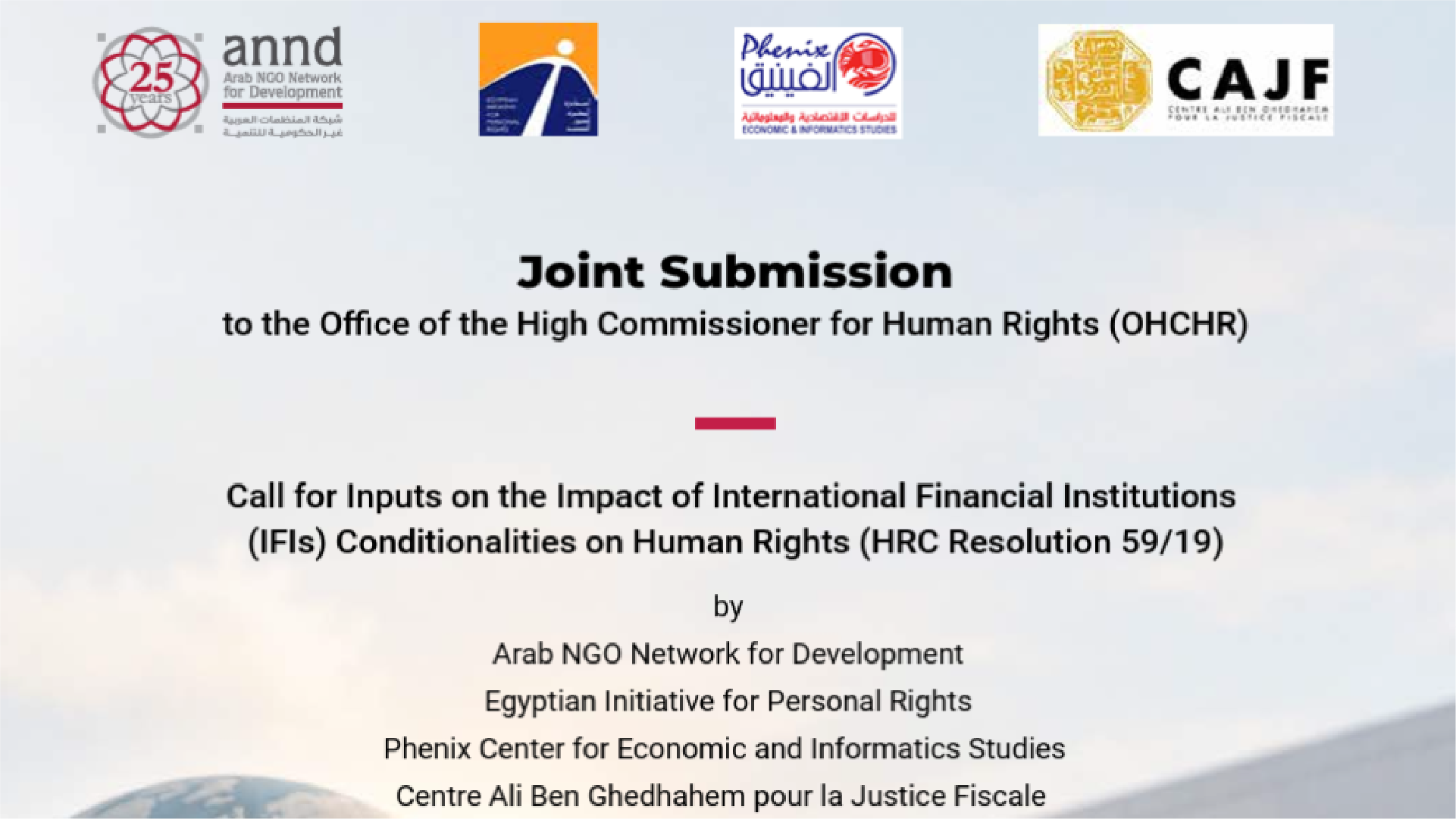
Joint Submission to OHCHR: Impact of International Financial Institution Conditionalities on Human Rights
Call for Inputs under Human Rights Council Resolution 59/19
Jointly submitted by:
Arab NGO Network for Development (ANND)
Egyptian Initiative for Personal Rights (EIPR)
Phenix Center for Economic and Informatics Studies
Centre Ali Ben Ghedhahem pour la Justice Fiscale
About the Submission
The submission examines how conditionalities associated with international financial institution programmes are negotiated, designed and implemented, and considers the extent to which human rights and distributional impacts are incorporated into these processes.
Drawing on experiences from Egypt, Tunisia and Jordan, it assesses the relationship between macroeconomic adjustment and economic, social and cultural rights, including the effects of fiscal consolidation, subsidy reforms, taxation, monetary policies, public-sector measures and debt-servicing obligations.
Human Rights, Social Protection and Fiscal Space
The submission highlights the importance of assessing IFI-supported reforms not only through macroeconomic indicators, but also through their longer-term implications for development, debt sustainability, social justice and distributional outcomes. It examines the pressures that debt servicing and adjustment policies can place on the resources available for health, education, social protection, public investment and other economic and social priorities.
It also considers the role and limitations of compensatory measures such as targeted cash transfers and social spending floors, arguing for stronger integration of social objectives into the design and pace of macroeconomic frameworks.
Civic Space and Participation
The submission addresses civil society participation in IFI policy processes and calls for more meaningful, transparent and accountable engagement. Recommendations include the systematic inclusion of civil society perspectives, clearer consultation timelines and documentation, structured outreach ahead of country missions, and mechanisms to demonstrate how civil society input has been considered.
Towards Stronger Human Rights Safeguards
Among its recommendations, the submission calls for stronger human rights monitoring and ex ante distributional and human rights impact assessments for major macroeconomic conditionalities. It also argues that social protection should be integrated into macroeconomic programme design rather than treated primarily as compensation after adjustment measures have been adopted.
The submission further calls for assessments of fiscal space that take debt-interest payments into account and for social protection floors to be linked to inflation and poverty data, alongside stronger accountability and participation throughout IFI-supported programmes.
Recent publications