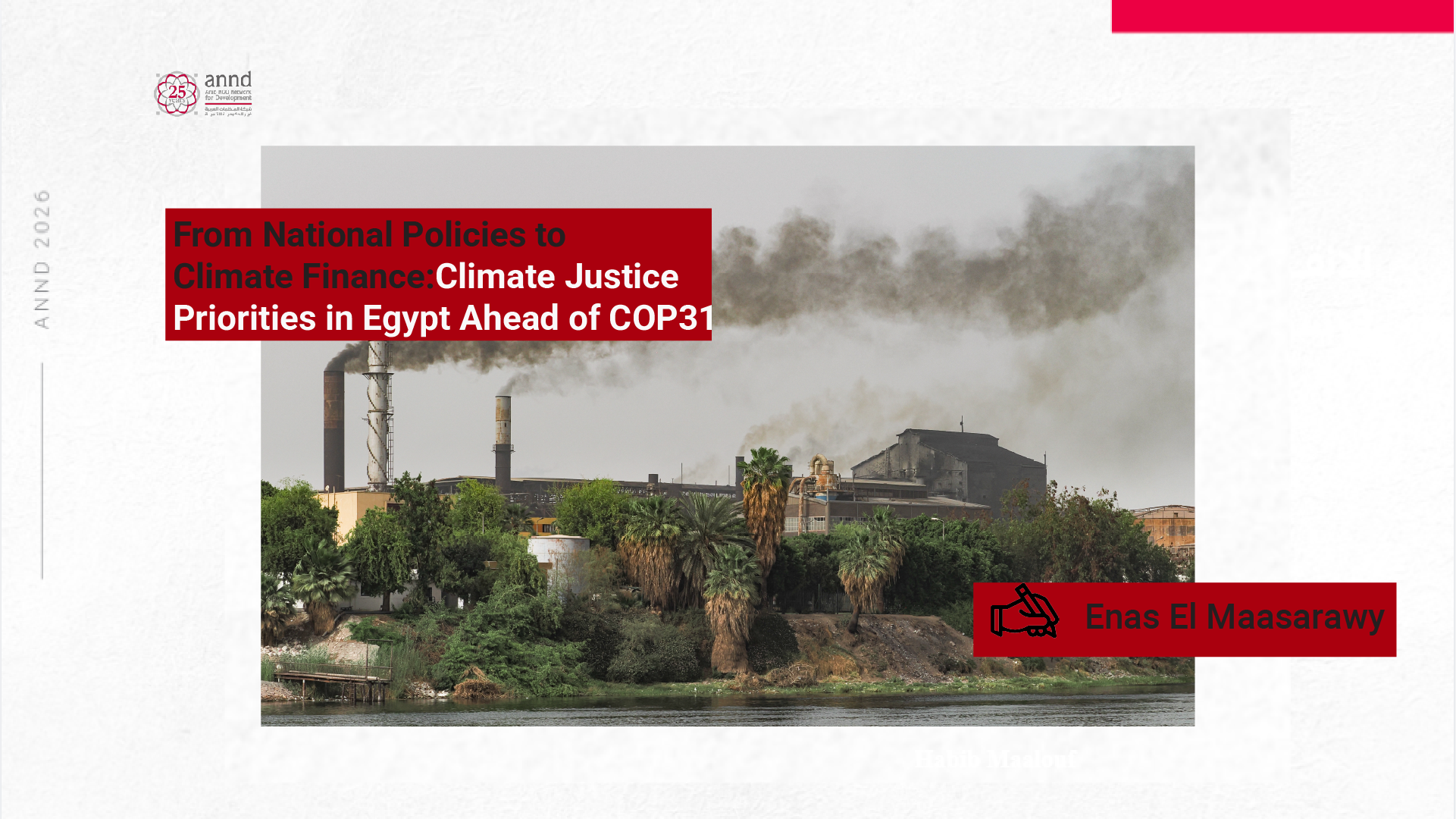
From National Policies to Climate Finance: Climate Justice Priorities in Egypt Ahead of COP31 - Enas El Maasarawy
From National Policies to Climate Finance: Climate Justice Priorities in Egypt Ahead of COP31
Editorial Summary
As COP31 convenes in Antalya, this article examines climate justice in Egypt through the lived experiences of factory workers, smallholder farmers, rural women and fishing communities. It highlights how pollution, rising temperatures, water scarcity and environmental degradation threaten livelihoods and public health, while the costs of the green transition risk falling disproportionately on vulnerable groups. The article calls for grant-based climate finance that does not deepen debt, a just transition that protects workers, transparent financing mechanisms and meaningful civil society participation in climate decision-making.
Climate Is Not a Luxury — It Is a Matter of Livelihood
Until recently, climate change was perceived as a distant concern, even a luxury disconnected from the everyday worries of ordinary people. Today, however, it has become an urgent reality that touches every aspect of daily life. Climate is inextricably linked to the fundamental right to life, affecting everything from the air we breathe and the water we drink to the crops, fish, and meat we consume. Its consequences are increasingly felt in electricity bills, medical prescriptions, and the price of a loaf of bread.
As the 31st United Nations Climate Change Conference (COP31) convenes in Antalya, Türkiye, from November 9 to 20, 2026, a fundamental question demands attention: Are climate policies and financing mechanisms actually reaching those who bear the heaviest burden of climate change?
In industrial areas, factory workers and nearby communities are exposed daily to smoke, dust, and harmful emissions. The persistent exposure poses serious health risks, contributing to respiratory problems, sinus infections, and chronic illnesses.
A worker at a major detergent factory in Port Said confided in me, “I know my life will be short.” When I asked him what he meant, he replied, “Either I keep working, or I won't be able to feed my children. Our lives are in God's hands.”
In rural areas, smallholder farmers are experiencing the effects of drought and rising temperatures firsthand. Water resources are dwindling, crop yields are declining, and production costs are soaring, placing already vulnerable farming communities under mounting economic pressure.
Rural women bear a double burden. Alongside their work in the fields, they shoulder the responsibilities of household management and family care. Some must travel between governorates twice a week to sell their locally produced goods, exposing themselves to the risks of travel while adding to their already demanding workloads.
In coastal cities, fishermen rely on the sea and nearby lakes for their livelihoods. Yet rising water temperatures, worsening pollution, and dwindling fish stocks are threatening their ability to earn a living. Many return from their fishing trips with empty nets, and few, if any, have alternative source of income.
The consequences extend beyond fishermen to women working along the blue economy value chain, many of whom suffer from respiratory problems and skin conditions associated with their working conditions and direct contact with fish and shellfish. Some of these women told me that the fish were “eating away at their hands,” a poignant description of the painful cracks and sores caused by working in extreme temperatures. In winter, when the fishing season begins, their hands and feet become swollen and numb from prolonged exposure to the bitter cold. Yet they have little choice but to continue working. With no alternative sources of income, family breadwinners, and inadequate social protection, they struggle to secure a decent standard of living.
Factory workers, women farmers, fishermen, and women working in supporting roles are among the most vulnerable groups, often drawn from the poorest segments of society. Their livelihoods, health, and well-being are directly threatened by climate change and environmental degradation. Yet their voices remain largely absent from the decision-making processes that shape their lives, even as policies are developed in their name and presented as measures intended to protect their interests.
Health and Water: Heat and Pollution Threaten Our Environment and Well-Being
At Lake Manzala, which has shrunk to less than two-thirds of its original size and is connected to the Mediterranean Sea and the Suez Canal, the environmental and public health risks associated with pollution are becoming increasingly apparent.
Speaking to Raseef22, Dr. Mahmoud Hanafi, a professor of marine environmental sciences, explained that industrial wastewater containing hazardous chemicals can lead to the accumulation of toxic substances in fish tissues. Consuming contaminated fish may pose serious health risks, including damage to kidneys and liver and an increase risk of certain cancers. Exposure to elevated levels of heavy metals, particularly cadmium and lead, may also impair children's cognitive development.
Approximately 65 fish farms are located around the lake, many of which have reportedly been abandoned by their owners following repeated financial losses attributed by sewage and industrial waste discharged along the shoreline and directly into the lake.
In recent years, our cities and villages have witnessed what has come to be described as the "massacre of trees." Decades-old trees that once served as natural barriers against extreme heat, providing shade, and contributing to ecological balance, have been cut down, ostensibly to make way for major road widening, bridge construction, or canal-lining projects.
Replacing these mature trees with small saplings, in an attempt to appease public anger, cannot make up for the environmental damage caused by their removal. Young trees cannot immediately replicate the vital benefits provided by mature trees, particularly their capacity to absorb carbon dioxide, improve air quality, provide shade, and mitigate extreme heat.
As temperatures continue to rise and the impacts of climate change intensify, there is an urgent need to reconsider practices that result in the destruction of this vital tree cover. Preserving these trees is essential, as they constitute a vital line of defense against extreme heat and play a crucial role in protecting public health, maintaining ecological balance, and improving quality of life.
Who Pays the Price of Pollution and the Green Transition?
Polluting emissions cannot be viewed in separation from the structure of the global economy and the unequal distribution of wealth and environmental burdens. While major industrialized nations derive substantial economic benefits from industrial and commercial activities, communities elsewhere bear a disproportionate share of the environmental costs. Hazardous industries and toxic waste are transferred to developing countries where environmental regulations are poorly enforced and transparency is limited. Nevertheless, our governments also bear responsibility for rejecting environmentally harmful investments, enforcing stringent environmental and occupational standards on both domestic and foreign companies, and ensuring compliance with these regulations.
The question is no longer whether a transition to a more sustainable economy is necessary, but rather who will shoulder its costs and who will benefit from opportunities. Three major risks emerge in this context.
The first is the prospect of rising prices and reduced subsidies, which could place a disproportionate financial burden on ordinary citizens while allowing the economic benefits of the transition to remain concentrated among investors.
The second is the prioritization of large-scale projects over the pressing needs of villages and local communities, particularly their access to safe drinking water, healthcare services, and essential infrastructure.
The third is the absence of adequate worker retraining and skills development programs ahead of the transition. Without such measures, many workers risk losing their jobs without the social safety nets or alternative employment opportunities needed to maintain a decent standard of living.
Unless these risks are addressed, the green economy, intended as a pathway toward a more sustainable and equitable future, could instead become an additional burden on the poorest segments of society, turning the green transition into a bleak reality for society’s most vulnerable.
Climate Finance: A Genuine Necessity, Provided It Does Not Create New Debt
Egypt is among the countries particularly vulnerable to climate-related risks, notably rising sea levels that threaten low-lying areas of the Nile Delta and coastal communities, as well as increasing water scarcity. Yet financing climate adaptation projects through additional borrowing risks deepening the country’s debt burden and placing further economic pressure on citizens, particularly poor and low-income households. It is therefore crucial to distinguish between grants and concessional financing, which industrialized countries have a particular responsibility to provide, and commercial loans or financing arrangements with conditions that could exacerbate existing debt pressures.
Announcing climate finance commitments is not enough. What ultimately matters is whether these funds reach the communities and vulnerable groups they are intended to support. Bureaucratic barriers and limited transparency can prevent resources from reaching those most in need. Overcoming these obstacles requires meaningful partnerships with civil society organizations, cooperatives, women's groups, and trade unions to ensure that climate finance translates into tangible benefits at the community level.
Transparency is equally essential to the fair and effective distribution of climate finance. Citizens have the right to know how much funding is available, who receives it, how it is allocated and spent, and what conditions accompany it. Equally important is the establishment of an independent, accessible, and secure grievance mechanism through which affected communities can raise concerns, seek redress, and hold the responsible authorities accountable.
What Is Egyptian Civil Society Bringing to Antalya?
Egyptian civil society is bringing a central demand to Antalya: fair, new and additional climate finance that prioritizes grants over loans that exacerbate the debt burdens of vulnerable countries, places climate adaptation projects at the forefront, and ensures that funding reaches local communities directly.
It is also calling for a just transition that protects the rights of women and men workers, places gender equality at the heart of climate policies, and ensures that the Fund for Responding to Loss and Damage caused by climate change is fully operational.
Equally important are transparency and accountability. Egyptian civil society is calling for the public disclosure of climate finance sources, allocations, and expenditures, alongside the meaningful participation of women, young people, and trade unions in the decisions that shape climate policies and determine how resources are distributed.
Finally, it rejects the transfer of environmental risks and burdens onto already vulnerable communities, reaffirming the right of every person to a clean, healthy, and sustainable environment and the importance of holding polluters accountable for the harm they cause.
A Final Word
Climate justice cannot be achieved through empty promises or polished declarations that dominate international conferences. It will become a tangible reality only when factory workers can breathe clean, safe air in and around their workplaces; when farmers have access to their fair share of water, sufficient to irrigate their land and sustain a dignified livelihood; and when fishermen can return home with enough fish to provide for their families, caught from lakes free of lead and other harmful pollutants.
True climate justice is not measured by the magnitude of the financial commitments announced in official statements and reports, but by whether those resources actually reach the people who need them most. It is measured by citizens' access to transparent information and reliable, verifiable data that enable them to hold the responsible authorities accountable. Above all. It is measured by the tangible improvements it brings to peoples’ health, livelihoods, and fundamental right to life.
Disclaimer: The views and opinions expressed in this article are those of the author and do not necessarily reflect the official position of the Arab NGO Network for Development (ANND).
Recent publications
Waste on the COP31 Agenda: A Billion-Dollar Industry and Risks for Future Generations - Habib Maalouf