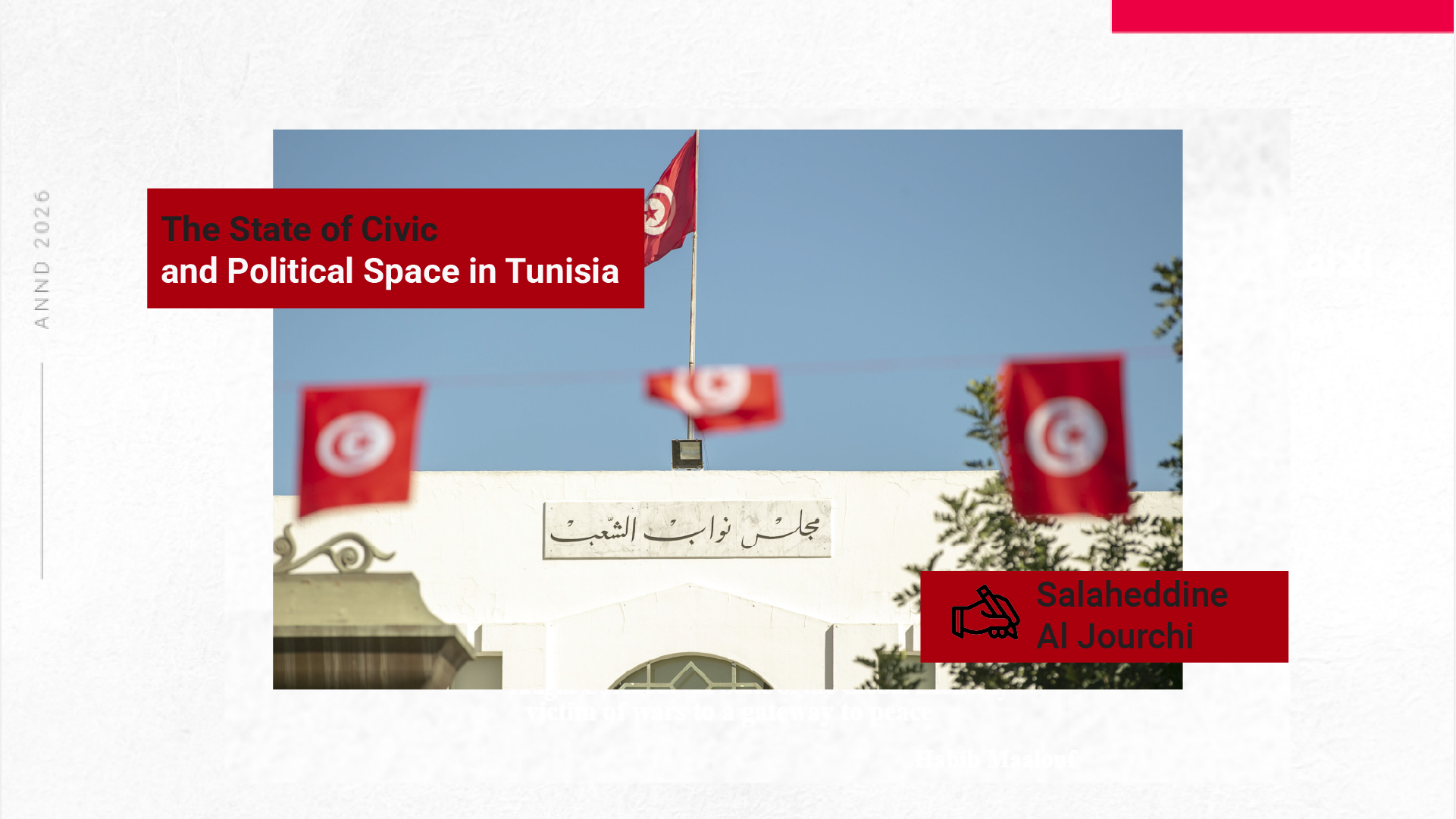
The State of Civic and Political Space in Tunisia: The Expansion of State Power and the Economic Crisis Threaten the State and Society
The State of Civic and Political Space in Tunisia: The Expansion of State Power and the Economic Crisis Threaten the State and Society
By Salaheddine Al Jourchi
Civic and political space continues to be subjected to attempts by the authorities to undermine the foundations on which its existence rests, in an effort to limit its independence, freedom of movement, and ability to exert influence. At the same time, however, there is a tangible determination to resist, endure, and confront these pressures. This is reflected in various forms, most notably efforts to make use of the crises that have unfolded rapidly and intensely in recent months, affecting vital aspects of Tunisians’ daily lives, and to transform them into a sustained state of protest. The hope is that this may help reshape the balance of power between the authorities, on the one hand, and the organized bodies within the civic and political sphere, on the other. Yet disagreements and conflicts among the components of political and civil society persist. Although they have somewhat diminished, they continue to pose a significant challenge, obstructing this mobilization and preventing it from acquiring the strength necessary to impose its demands and accelerate the process of change.
Tunisians went through exceptional circumstances this summer, which reached their peak during the summer months and may continue into September. The crises of electricity cuts and disruptions to the supply of drinking water intensified, resulting in a severe shortage of bottled mineral water and bringing Tunisians close to facing acute water scarcity. This followed a series of fires that affected some of Tunisia’s most important forests as a result of rising temperatures. These developments had a severe impact on Tunisians’ living conditions and way of life, prompting some military units to intervene to help distribute water in certain areas, while the President of the Republic renewed his accusation that a hidden force was behind the water and electricity cuts as a result of “deliberate acts.”
This year in particular has witnessed a succession of crises affecting numerous basic goods on which Tunisians depend, including medicines, sugar, vegetable oil, milk, butter, semolina, pasta, rice, coffee, tea, poultry, red meat, fuel, gas cylinders, potatoes, iron, compound animal feed, schoolbooks and notebooks, and agricultural fertilizers. These crises have exposed a growing inability to address the situation, leaving Tunisians emerging from one crisis only to find themselves caught in others.
This does not mean that the period preceding President Saied’s assumption of absolute power was free of some of these crises. What is striking, however, is that their recurrence and simultaneity have become faster and more widespread than before. This indicates that the structural dysfunction resulting from current economic policies has become deeper and more dangerous compared with the situation in previous periods.
This has generated a state of alarm, with growing questions about where these conditions may lead in the near future and about the need to consider possible alternatives capable of addressing the challenges. Through statements and social media, some have argued that the problem currently facing the country goes beyond merely calling for President Saied’s resignation. Rather, they argue that the fundamental problem lies in the absence of mechanisms capable of ensuring a safe institutional transition, away from the possibility of the collapse of the state and its institutions and while avoiding scenarios involving military intervention or chaos.
It is widely recognized that Tunisia’s political parties, without exception, have found themselves weakened after five years of absolute rule and are currently unable to take the lead in the political landscape. Their leaders are in prison, while the political weight of their supporters has diminished as a result of restrictions on civic and political space. This has been compounded by the gap separating these parties from the broader Tunisian population, as participation in public affairs has declined and confidence in political parties and in the usefulness of political engagement has eroded. Nevertheless, a minimum level of party presence remains, varying in strength and influence.
Civil society today appears to be attempting once again to move to the forefront, despite the blows suffered by various associations, particularly those working in the fields of political and civic development, much as it did during the era of President Ben Ali.
Within this context, the “Nafas” initiative was established. Its founders described it as a “peaceful civic citizens’ movement, open to different segments of society, including journalists, lawyers, academics, bloggers, and activists,” with the aim of defending fundamental freedoms, foremost among them freedom of expression. Its founders stated that they were a group of activists unaffiliated with political parties.
By the time this article was written, the initiative had succeeded in organizing three marches and had managed to energize the political and social landscape despite numerous difficulties. In particular, it succeeded in overcoming disagreements between political parties, especially between the Free Destourian Party and the Ennahda Movement. The marches were considered noteworthy because they brought together most political forces and attracted the participation of thousands of Tunisian men and women from different political and social backgrounds and orientations.
One of the initiative’s founders, Seifeddine Arfaoui, was arrested following his participation in the most recent march, on the basis of Article 86 of the Telecommunications Code concerning “offending others through public telecommunications networks.”
This climate, characterized by restrictions on freedoms, pushed the leadership of the Tunisian General Labour Union toward withdrawal and a lower public profile over recent months. More recently, however, it has been attempting to move beyond this period of stagnation, suggesting that it may, to some extent, abandon its “policy” of avoiding confrontation with the authorities and accepting the minimum possible.
The recent meeting between the Union’s Secretary-General and the President of the Bar Association reportedly took place within the framework of preparations by the Union to join other national organizations in undertaking a “national action to defend the country’s achievements,” although the nature of this action was not specified.
The regional labour union in the city of Sfax, known for its history of activism within the trade union movement, also issued a strongly worded statement expressing its categorical rejection of “the policy of monopolizing power, excluding social actors, and undermining trade union activity.” It also stressed that the “conspiracy discourse” used by the authorities to intimidate their opponents and civil society and to justify successive social crises “no longer convinces public opinion.” It strongly criticized what it described as the “complete failure of the July 25 system.”
The withdrawal of the Tunisian General Labour Union from the social and political scene over recent months has had a negative impact on Tunisia and enabled the authorities to take sole control of the country’s leadership while excluding or marginalizing other active forces. This is primarily attributable to the profound internal crisis experienced by the Union, the repercussions of which remain present today. The action that the trade union leadership intends to undertake may help, even if only relatively, to adjust the balance of power and attempt to confront the major setbacks taking place in the social sphere.
All indicators suggest that September and the months that follow will be politically and socially heated as the social crisis deepens. This prompted a number of members of parliament, elected during the second presidential phase of the current period, to call for an urgent and extraordinary plenary session to discuss conditions in the country and address the current comprehensive crisis.
They described the situation as “extremely dangerous” following the increase in the number of victims of heat-related suffocation, shortages of basic goods, and mounting social tension. In their statement, these members of parliament stressed that the crisis “goes beyond temporary disruptions and raises questions about the state’s ability to manage crises.”
Tunisia is going through a difficult period that is more dangerous and fragile than the years that followed the revolution. This has opened the way for observers to question the extent to which the current authorities are capable of enduring and addressing the major, multiple, and simultaneous problems facing the country, particularly at a time when influential political parties, civil society organizations, and social forces are noticeably weak and are not prepared to manage public affairs in the absence of a political and social program.
Recent publications
Who Enters the Age of Electricity? And Who Pays the Price? - Habib Maalouf