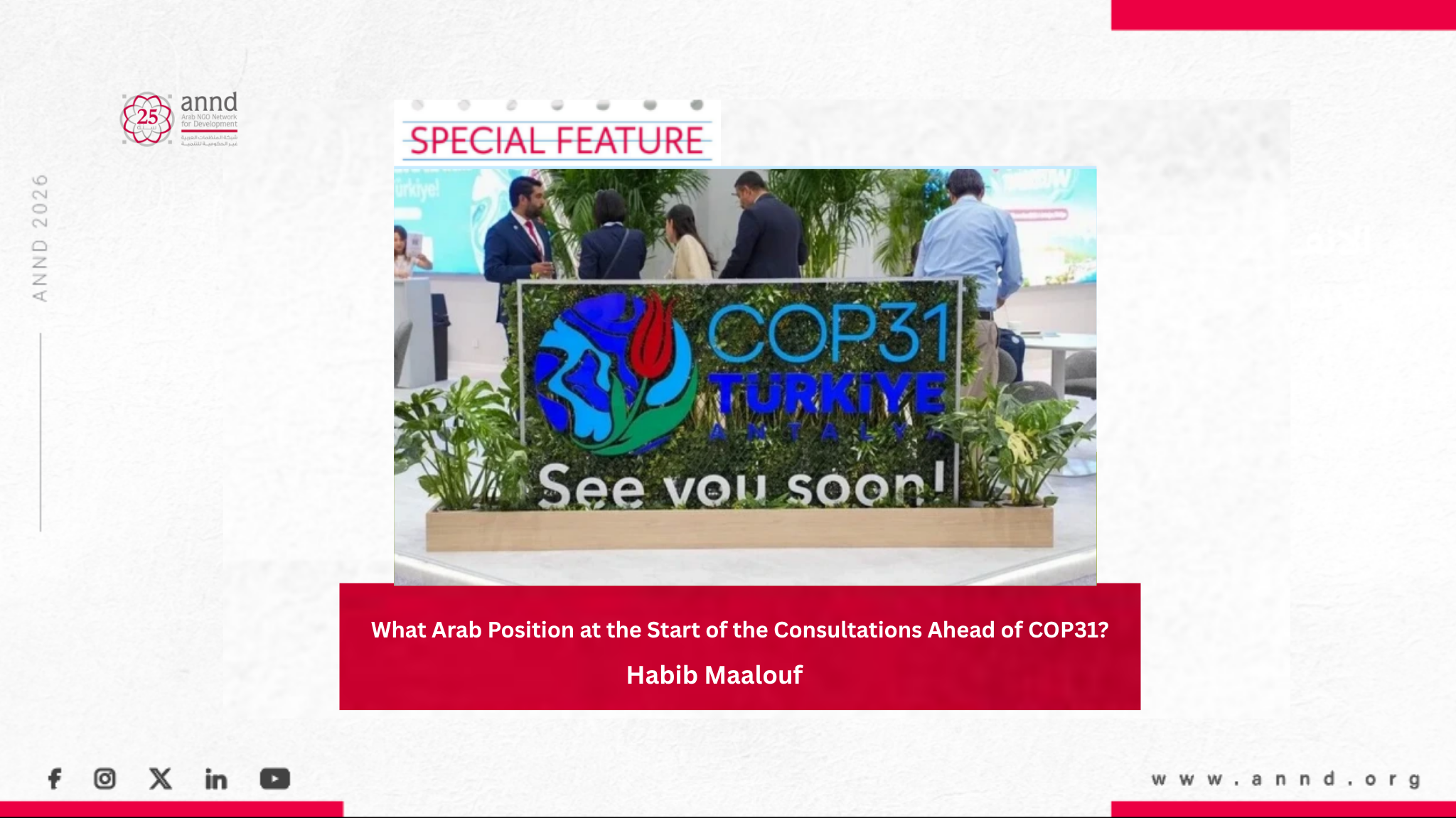
What Arab Position at the Start of the Consultations Ahead of COP31? - Habib Maalouf
What Arab Position at the Start of the Consultations Ahead of COP31?
By Habib Maalouf
Today, 14 October 2026, the Heads of Delegation Consultations (HOD Consultations) began. These are “virtual” consultations described by the Secretariat as “informal,” held in preparation for setting the agenda for the COP31 negotiations. The Arab negotiating group prepared for them with a paper aimed at consolidating the priorities of developing countries in the COP31 negotiations and preventing the centre of gravity from shifting away from multilateral negotiations towards voluntary initiatives led by the Presidency, while emphasizing finance, technology, climate justice, and the right to development.
The importance of this paper lies not only in what the Arab Group is demanding, but also in what it reveals about disagreements within the negotiations and about the attempt to reconcile, on the one hand, the implementation of the Paris Agreement and, on the other, objections to trade, technological, and economic policies that could turn the climate transition into a new source of inequality between countries.
So what is the position of the Arab negotiating group, and what is the position of Arab civil society, ahead of COP31 in Antalya?
1. Priority for Formal Negotiations over Voluntary Political Initiatives
The Group calls for COP31 decisions to arise from agreed mandates and for negotiations to remain transparent and Party-driven, rather than allowing initiatives selected by the COP Presidency to replace the formal negotiating agenda.
It does not reject the Global Climate Action Agenda in itself, but wants it to remain a complementary track to the negotiations rather than a substitute for them. The reason is that voluntary initiatives do not require the approval of all countries and, if mixed with the formal process, may become a means of imposing priorities that do not enjoy international consensus.
2. Climate Finance: Objection to Backtracking on Commitments
The Group points to the decline in climate finance and calls for strengthening the Adaptation Fund, making progress under the climate finance work programme, securing an ambitious replenishment of the Green Climate Fund, and preventing backtracking on pledges, contributions, and projected finance under Article 9, paragraph 5, of the Paris Agreement.
The core argument of the negotiating paper is that the implementation of developing countries’ commitments cannot depend on shrinking promises or uncertain finance. However, the intervention does not set a new numerical finance target, nor does it detail how the burden should be distributed among developed countries.
3. Rejection of Unilateral Climate-Related Trade Measures
The Group objects to unilateral trade measures linked to climate, particularly those with effects extending beyond national borders, and calls for what it considers restrictive measures to be addressed through multilateral cooperation.
In the broader context, this refers to measures such as carbon border adjustment mechanisms, including the European mechanism known as CBAM, although the paper does not name it explicitly.
The Arab argument is that climate should not become a justification for imposing external trade rules or for zero-sum competition that imposes additional costs on developing economies without taking into account differences in their capacities and responsibilities.
4. Technology Transfer and Manufacturing in the Global South
One of the most prominent points in the paper is its objection to developing countries continuing to provide raw materials while advanced technologies are produced abroad using those materials, then sold back to them at high prices and protected by patents.
The Group calls for greater and higher-quality climate finance, genuine technology transfer on preferential terms, and a fair geographical distribution of value added, manufacturing, and employment opportunities.
This point goes beyond the idea of technology transfer as a technical exchange. It raises questions about who owns the technology, who possesses the raw materials, who makes the profits, and who bears the cost of the climate transition.
5. Adaptation to Warming and Exceeding the 1.5°C Threshold
The Group acknowledges that the possibility of exceeding the 1.5°C threshold has become a reality for which preparations must be made. It emphasizes the need to accelerate progress on adaptation, particularly within the framework of the Global Goal on Adaptation (GGA), and to listen to the needs of the Global South.
It also links this issue to carbon dioxide removal, capture, utilization, and storage technologies, considering them part of the debate over overshooting the temperature threshold and limiting warming.
Here, it is important to distinguish between two issues. Agreement on the need for adaptation does not mean agreement on how it should be financed or measured. Likewise, reference to carbon removal and capture technologies does not mean that all such technologies are equal in effectiveness, maturity, or suitability for every country.
It should also be noted that Arab civil society, in previous positions, has expressed reservations about oil-producing countries spending large amounts of money on this technology, which has not gained broad recognition, rather than financing the transition to and localization of renewable energy and other adaptation measures.
6. Protecting the Independence of Science
The Group calls for scientific processes to be protected from political agendas and for sufficient time to be provided for experts and institutions in developing countries to participate.
This is an important demand because the production of climate knowledge, the identification of priorities, and scientific assessments should not be monopolized by institutions with greater funding and greater capacity to participate.
Arab civil society adds to this demand the need to free green technologies from World Trade Organization rules and remove intellectual property protection from them.
7. Response Measures, Just Transition, and the Right to Development
The Group warns that policies responding to climate change may impose additional economic burdens on developing countries even when they are intended to reduce emissions.
It therefore calls for progress on Response Measures and Just Transition.
It draws on a historical and ethical argument: countries that have contributed more heavily to consuming the global carbon budget should not impose restrictions on other countries’ right to development and industrialization without providing finance, technology, and appropriate alternatives.
What Does the Paper Say About Disagreements Within Climate Negotiations?
Several fundamental disagreements can be inferred from the text: the management of the conference, priorities and initiatives and their role, the extent of compliance with commitments, increasing finance, rejecting unilateral measures, prioritizing adaptation, and holding developed countries responsible for providing the means of implementation, alongside concern over whether the climate transition will lead to fair cooperation rather than reproduce economic dependency.
These disagreements are not new, but they acquire additional importance as the world shifts from agreement on targets towards competition over markets, technologies, strategic minerals, and supply chains.
There may be broad consensus on the need to transition towards a low-emissions economy, but that does not mean there is consensus on who owns the tools of this transition, who finances it, or who captures its economic benefits.
It should also be noted that the formal negotiating position and the text speaking on behalf of the Arab Group, presenting common priorities that it seeks to defend in the negotiations, may not necessarily express actual national interests.
Arab countries are not identical in their economic, energy, or climate circumstances. Some are oil and gas exporters; others depend on energy imports; some are highly vulnerable to water scarcity and rising temperatures; and others face acute financial and development crises.
These differences do not negate the existence of common interests, but they raise a question about the Group’s ability to turn the discourse of climate justice into a programme of action that takes into account the different circumstances of its members.
Fossil-fuel exporting countries may attach greater importance to response measures and the right to development, while other Arab countries may be more urgently concerned with securing finance for adaptation, water, food security, and loss and damage.
Likewise, objecting to unilateral trade measures does not relieve Arab countries of the need to develop industrial and energy policies that make their economies less vulnerable to such measures in the future.
Here lies one of the important opportunities for Arab civil society: holding governments accountable for how the benefits of finance, technology, and the energy transition are distributed within the region, and not only for their positions vis-à-vis developed countries.
Despite the importance of the intervention, several points need clarification or further development if it is to be transformed into a stronger Arab position.
The paper linked exceeding 1.5°C with the need for carbon dioxide removal, capture, utilization, and storage. However, these technologies are not equivalent alternatives to reducing emissions at source, nor should they become a pretext for delaying the phase-out of fossil fuels.
It is essential to distinguish between carbon removal that results in the actual and permanent removal of greenhouse gases from the atmosphere, capturing emissions at their source, and technological promises that have not yet demonstrated their ability to operate at scale and at an acceptable cost.
As for the right to development, which civil society has also long demanded, it can be linked to developing countries’ right to industrialize, create jobs, and improve living standards.
But the question is: should they follow the same carbon-intensive development path taken by industrialized countries, or should technological and financial alternatives be provided that allow development without repeating the same damage?
Climate justice does not mean freezing existing inequalities in the name of reducing emissions, but neither does it mean granting every development project immunity from environmental accountability.
What is needed is to change the conditions of development and perhaps move beyond this concept towards a return to the older philosophy of sufficiency.
Conclusion: An Important Defensive Arab Position, but One That Needs an Alternative Project
It can be said that the Arab position is an important defensive position, but it needs an alternative project.
The Arab Group is defending three interconnected principles: fairness in finance, fairness in the distribution of technology and added value, and fairness in the climate transition while preserving the right to development.
At the same time, it is attempting to protect the multilateral negotiating process from being replaced by political or economic initiatives that do not enjoy consensus among states.
However, the strength of this position will not be measured only by its ability to object to declining finance, unilateral trade measures, or technological monopolies.
It will also be measured by its ability to present an alternative vision: How do we produce energy? How do we distribute its benefits? How do we protect water and food? How do we create jobs? And how do we ensure that the climate transition does not become a new race for control over resources and markets?
This opens up a fundamental area of action for Arab civil society at COP31: moving from defending developing countries’ right to development towards proposing the conditions for fair, low-emissions development that protects communities and resources and redistributes economic and technological power more equitably.
Ultimately, the issue is not only who reduces emissions and how quickly, but also who owns the means of reducing them, who pays the price, and who benefits from the new economy being built in their name.
Recent publications